Before anything else — the most important correction in this entire blog:
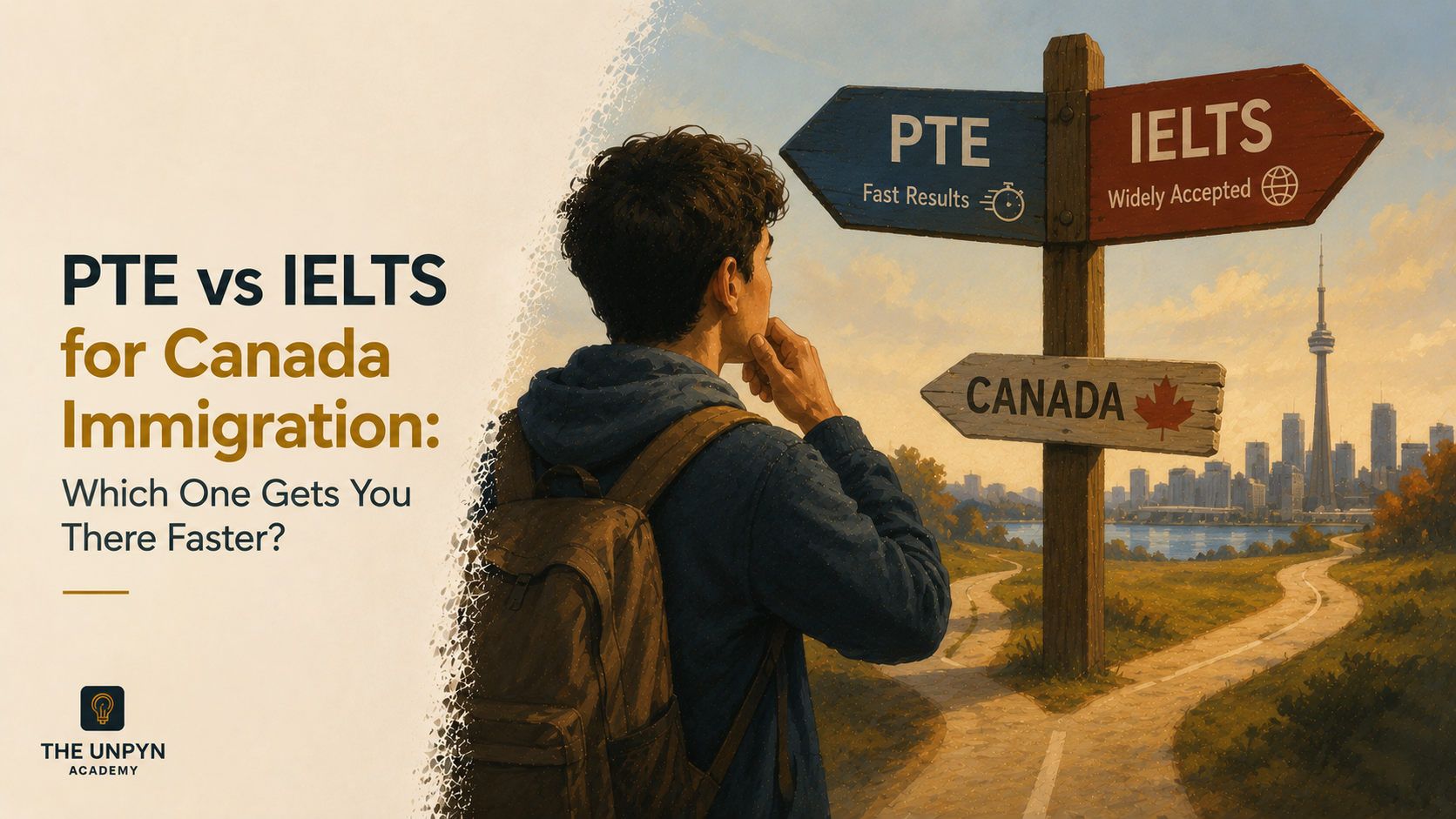
If you're applying for Canadian immigration, you need PTE Core. Not PTE Academic.
These are two entirely different tests. PTE Academic is for university admissions. PTE Core — also listed as PTE Home (Canada) on the Pearson VUE registration page — is the Pearson test accepted by IRCC for Express Entry, Provincial Nominee Programs, and other economic immigration pathways.
Taking PTE Academic for your Canada PR application is one of the most costly and common mistakes in this space. Your PTE Academic score cannot be submitted to IRCC. You would need to retake the test from scratch.
Confirm before you book: your registration should say PTE Core, not PTE Academic.
What IRCC Actually Accepts in 2026
Three tests are accepted by Immigration, Refugees and Citizenship Canada for economic immigration purposes:
- IELTS General Training — not IELTS Academic
- PTE Core — not PTE Academic
- CELPIP General
IELTS Academic, PTE Academic, Duolingo, TOEFL, OET — none of these are accepted by IRCC for PR or Express Entry applications.
The confusion between IELTS Academic and IELTS General Training, and between PTE Academic and PTE Core, catches a significant number of candidates who take the wrong version and either delay their application or pay twice.
How the Scoring System Works: CLB Is What Counts
IRCC doesn't use your raw IELTS band score or your PTE Core score directly. Every result is converted into a Canadian Language Benchmark (CLB) level, and that CLB level determines your eligibility and your CRS (Comprehensive Ranking System) points in Express Entry.
CLB runs from 1 (beginner) to 12 (advanced). For most PR pathways, CLB 7 is the minimum to be eligible at all. CLB 9 and above is where meaningful CRS points accumulate and where competitive Express Entry profiles are built.
The critical rule — the same as Australia's system, and equally misunderstood: IRCC uses your lowest CLB score across all four skills, not your average. If you score CLB 10 in Listening, Reading, and Speaking, but CLB 7 in Writing, your language profile is CLB 7. The points awarded are based on your weakest skill.
This means that chasing a very high score in three skills while leaving one at the minimum is a CRS points trap. Your preparation should bring all four skills as close together as possible, as close to CLB 9 as achievable.
CLB Conversion: IELTS General Training
| CLB Level | Listening | Reading | Writing | Speaking |
|---|---|---|---|---|
| CLB 7 | 6.0 | 6.0 | 6.0 | 6.0 |
| CLB 8 | 7.5 | 6.5 | 6.5 | 6.5 |
| CLB 9 | 8.0 | 7.0 | 7.0 | 7.0 |
| CLB 10 | 8.5 | 7.5 | 7.5 | 7.5 |
Note the jump from CLB 7 to CLB 8 in Listening (6.0 → 7.5) and Writing (6.0 → 6.5). These are not linear progressions. CLB 8 in Listening requires a 1.5 band improvement from CLB 7. Understanding where these thresholds are tells you exactly which score to target in preparation.
CLB Conversion: PTE Core
| CLB Level | Listening | Reading | Writing | Speaking |
|---|---|---|---|---|
| CLB 7 | 60–70 | 60–68 | 69–78 | 68–75 |
| CLB 8 | 71–81 | 69–81 | 79–87 | 76–83 |
| CLB 9 | 82–88 | 82–87 | 88–89 | 84–88 |
| CLB 10 | 89–90 | 88–90 | 90 | 89–90 |
Disclaimer: CLB conversion tables are based on official IRCC guidelines as of May 2026 and are subject to revision. Always verify current conversion tables directly at canada.ca/ircc before preparing for or submitting any immigration application.
The Speed Question: Which Gets You Results Faster?
This is where PTE Core has a clear, documented advantage.
| PTE Core | IELTS General Training (Computer) | IELTS General Training (Paper) | |
|---|---|---|---|
| Result turnaround | 24–48 hours | 3–5 days | Up to 13 days |
| Test availability | Most weekdays; flexible booking | Specific dates at authorised centres | Set test dates |
| Score validity | 2 years | 2 years | 2 years |
PTE Core dominates on speed — 24 to 48 hours versus 3–5 days for computer-delivered IELTS, and up to 13 days for paper-based IELTS. On tight PR timelines, near draw deadlines, or when you need to retake quickly after a missed score, this difference is operationally significant.
If your Express Entry profile is almost complete and you're waiting on a language score, every day matters — because draw rounds happen on a schedule, and a score arriving a day after a draw closes means waiting for the next one.
The One Skill Retake: Where IELTS Has a Structural Advantage
IELTS offers a One Skill Retake (OSR) — available for computer-delivered IELTS, booked within 60 days of the original test, retaking only the one section where you missed your CLB target.
PTE Core does not offer a single-section retake. If you take PTE Core and miss CLB 9 in Writing while hitting it in every other skill, you retake the full test.
For candidates who are strong in three skills and have one specific weakness, IELTS's OSR is a meaningful strategic advantage — it lets you fix the one problem without risking the three scores that are already where they need to be.
For candidates who need to improve across multiple skills simultaneously, or who simply need the fastest possible result, PTE Core is the more efficient choice.
The Format Comparison: Where Each Test Plays to Different Strengths
| IELTS General Training | PTE Core | |
|---|---|---|
| Speaking | Live face-to-face interview with a human examiner | Fully computer-based; AI-scored; no human examiner |
| Writing | Task 1: formal or informal letter; Task 2: essay | Integrated tasks: Summarize Written Text, Write Essay, Fill in the Blanks |
| Reading | Three sections with authentic text excerpts | Multiple task types including Fill in the Blanks, Re-order Paragraphs |
| Listening | Four sections; conversation to academic monologue | Integrated tasks; contributes to multiple skill scores |
| Scoring | Human examiners for Speaking and Writing; objective for Listening and Reading | Fully AI-scored across all four skills |
| Duration | ~2 hours 45 minutes | ~2 hours |
The Speaking variable: IELTS Speaking is a live 11–14 minute conversation with a certified examiner. This is a genuine advantage for candidates who express themselves more naturally in real conversation — where they can read the examiner, modulate their pace, and elaborate naturally.
PTE Core Speaking is AI-scored: no examiner, no adaptation, no human judgement. For candidates who feel more comfortable without being watched and evaluated in real time, this removes a significant source of anxiety. For candidates whose conversational strengths exceed their ability to perform structured spoken tasks under AI detection, IELTS may be the better route.
The Writing variable: IELTS Writing Task 1 (General Training) asks for a letter — formal, semi-formal, or informal. IELTS Writing Task 2 is a 250-word essay. Both are assessed by human examiners who can credit generally strong writing that has minor errors.
PTE Core Writing involves more integrated tasks and is AI-scored with less tolerance for approximation. Candidates with strong essay-writing backgrounds may find IELTS Writing more natural; candidates who type quickly and work well with structured computer-based tasks may find PTE Core easier to optimise.
Which Is Actually Easier? The Honest Answer
There is no universally easier test. The meaningful comparison is: for you specifically, which test format plays to your strengths?
PTE Core is likely the better choice if:
- You want results in 24–48 hours and speed is a priority
- You prefer AI-scored consistency without examiner variability in Speaking
- Your Speaking strength is in structured tasks rather than conversational English
- You're comfortable with computer-based integrated tasks
- You don't have a single-skill gap that would benefit from IELTS OSR
IELTS General Training is likely the better choice if:
- You perform better in live Speaking interviews than structured AI-scored tasks
- You have a specific one-skill gap that IELTS OSR could address
- Your target institutions or other applications (outside Canada) also require IELTS
- You're more familiar with the format and your mock IELTS results are already close to target
- You prefer human evaluation of Writing and Speaking
The Most Common Mistakes That Cost Months
Taking PTE Academic instead of PTE Core. Cannot be submitted to IRCC. Full retake required.
Taking IELTS Academic instead of IELTS General Training. Academic is not accepted for Canadian immigration. Full retake required.
Optimising one skill at the expense of others. CLB is determined by your weakest skill. CLB 10 in three skills and CLB 7 in one gives you CLB 7. Balanced preparation always outperforms a high ceiling with a low floor.
Not verifying score validity. IRCC requires test results to be less than two years old at the date they receive your application — not the date you submitted. If you tested in May 2024 and your application is processed in June 2026, your score has expired.