English Communication Training for Hotel Management & Culinary Institutes
Hotels and restaurants don't just hire on skill. They shortlist from institutes whose graduates communicate with confidence from day one.
- TESOL/TEFL certified trainers
- On-site or online
- Fortnightly reports
A student masters every station in the kitchen — break down a chicken, run a sauce, plate to standard. Then the executive chef at the placement interview asks them to describe their signature dish in English, and they go quiet.
The gap isn't that your students don't know English. It's the gap between the English they know and the English hotels and restaurants expect.
Why generic English training doesn't close it
A guest complaint, a kitchen command, an upsell at the table, a placement interview — each demands a register no general course teaches.
Grammar, vocabulary & conversational fluency
Useful foundations — but they stop exactly where the placement assessment begins. Knowing the words isn't the same as holding the conversation under pressure.
Situation-specific communication confidence
Greet and upsell a guest, handle a complaint, understand a kitchen command, and answer a placement-interview question — all with the same composure.
What hospitality-specific English training actually covers
Five communication situations your students will face in placement assessments and on the job — built into every session.

Guest interaction & front office communication
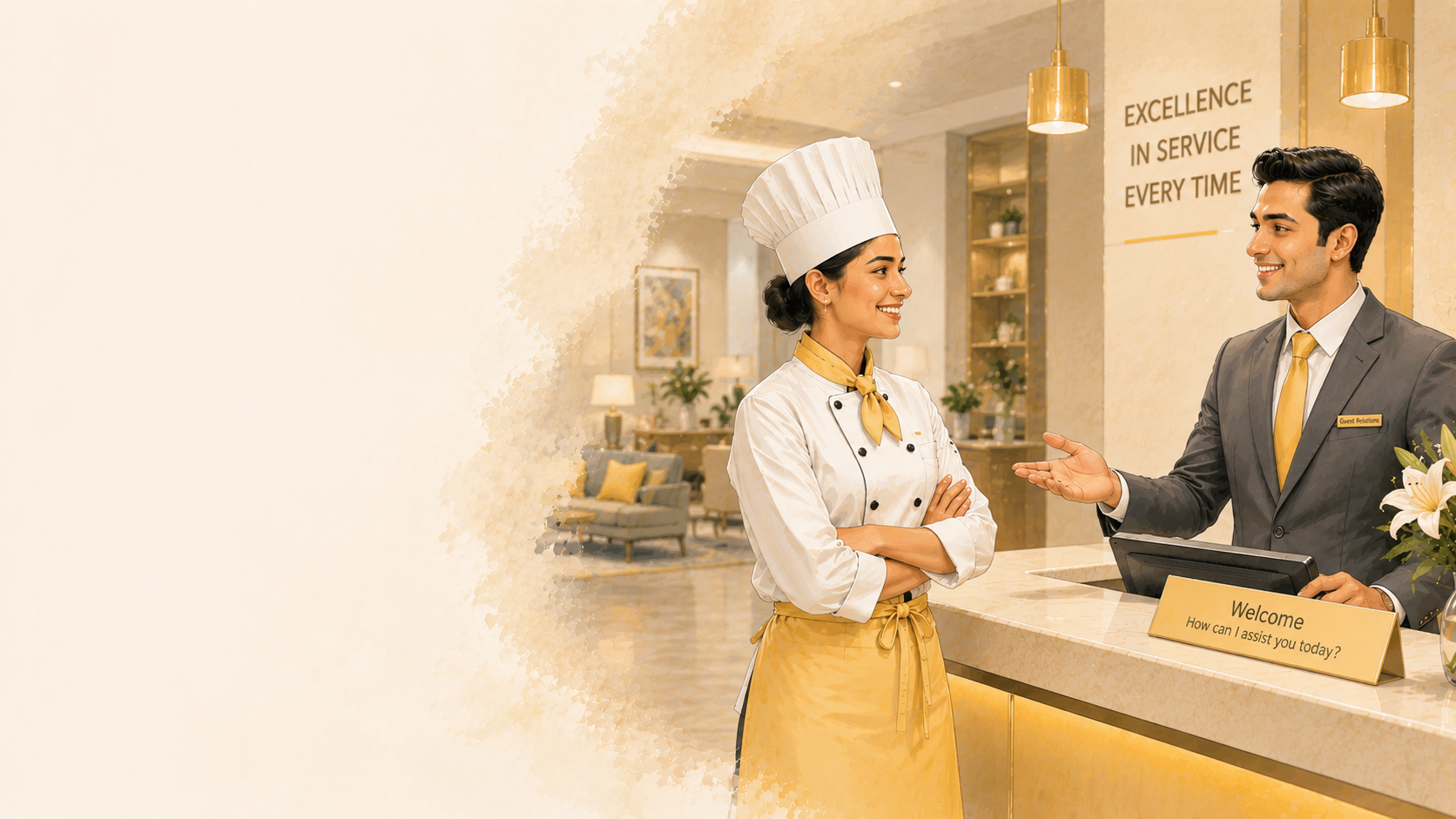
Welcome, inform, and assist guests — handle check-in and check-out, respond to requests, give directions, and explain services and charges clearly. Front office is the first and last impression a guest has of a property; students who communicate warmly and confidently here are exactly who recruiters shortlist.

Complaint handling & guest recovery
Acknowledge, apologise, and resolve — handle a guest unhappy with their room, a billing dispute, or a service failure, in English, without becoming defensive or going silent. Guest recovery is where service reputations are made or lost, and it is heavily assessed in placement role-plays.
Kitchen & culinary English
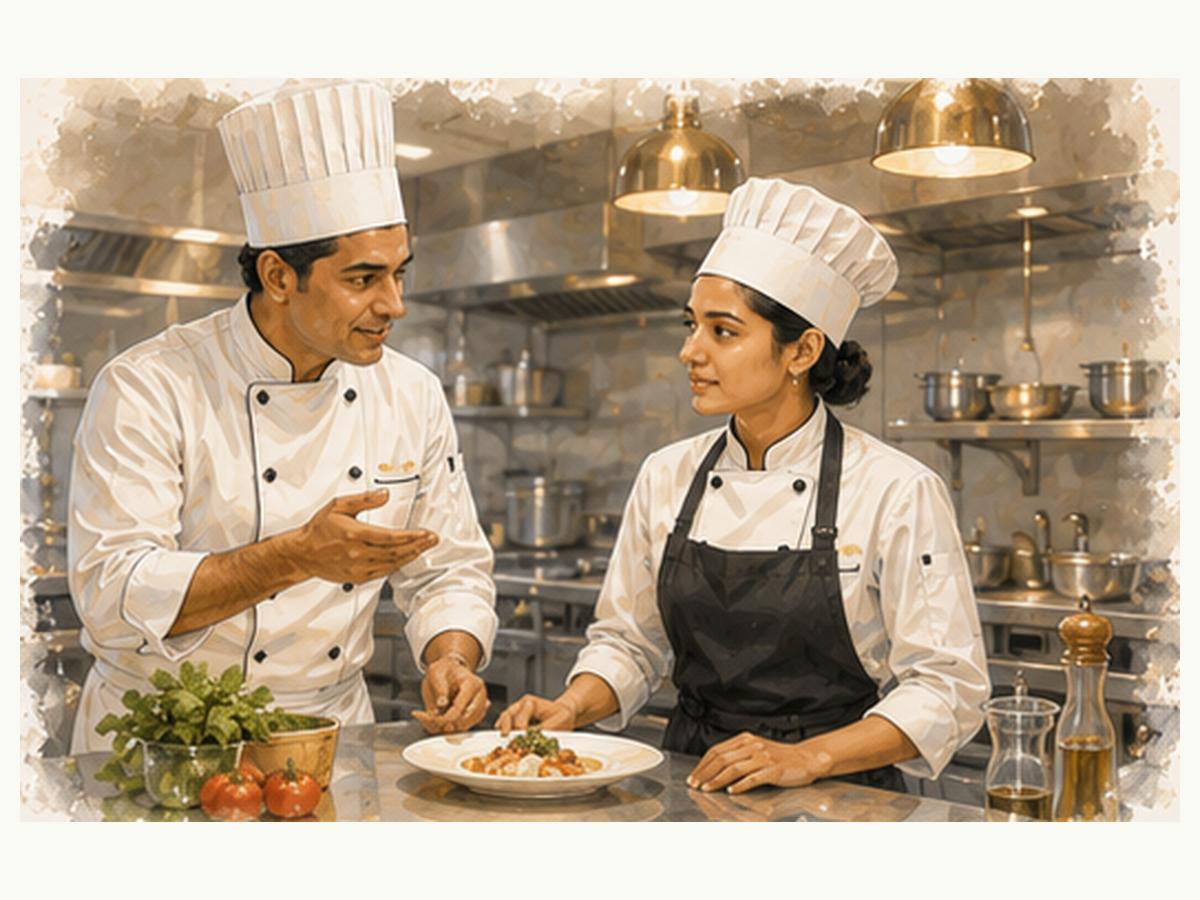
The vocabulary and command language of a professional kitchen — techniques, ingredients, equipment, and the brigade communication that keeps a busy service running. Many culinary students know the action but not the English term for it; we close that gap so they can work in any professional kitchen that runs on English.
Food & beverage service & upselling
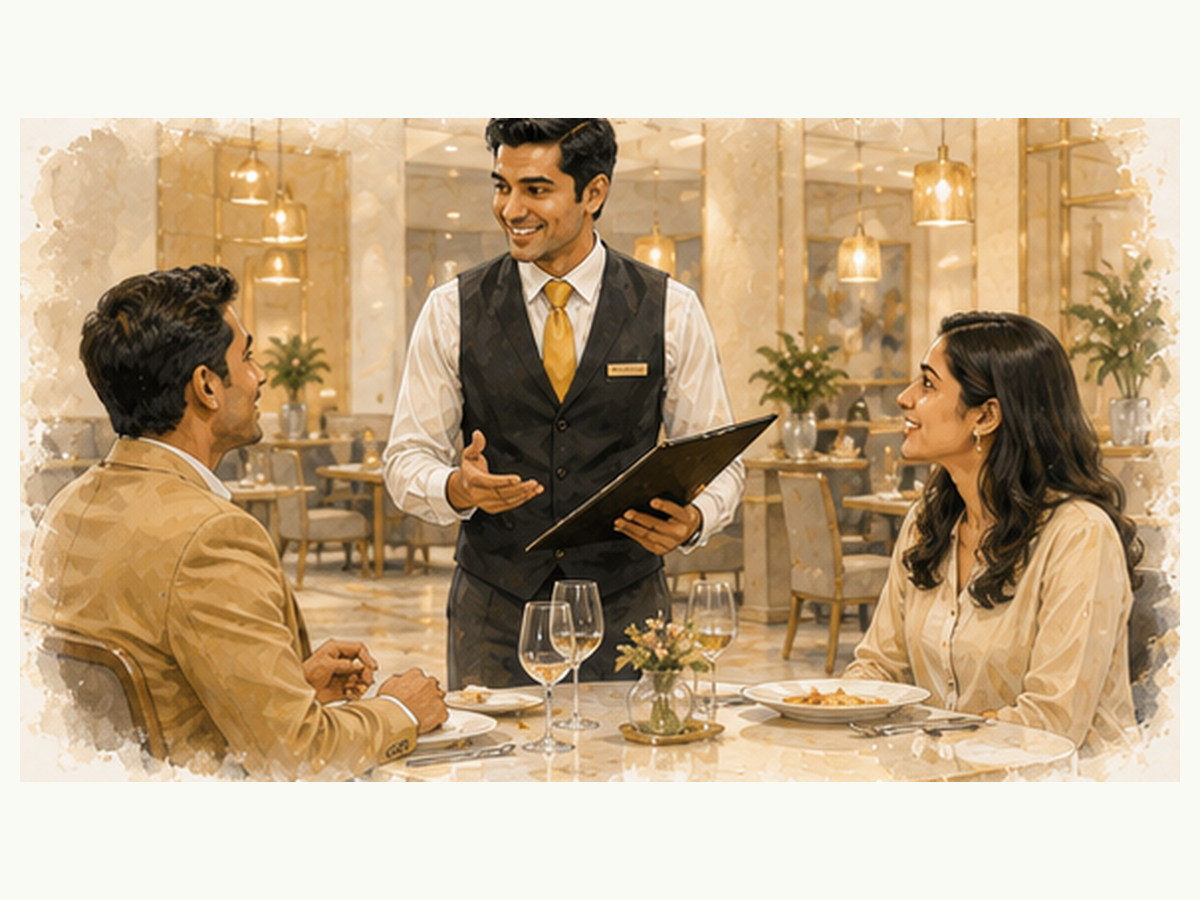
Take orders, describe dishes, recommend pairings, and upsell — the communication that directly affects a restaurant’s revenue per cover. Students who can describe a dish appetisingly and suggest a pairing confidently are an immediate asset to any F&B operation.

Placement interview & group discussion preparation
The specific English register and communication behaviours hotel and restaurant recruiters assess — self-introduction, situational questions, describing experience, and participating in group discussions without going quiet when the language switches to English. Students who have practised in this register perform measurably better in placement assessments.
Inside an Unpyn hospitality session: What actually happens
Students take real job roles. The trainer plays the guest. The correction happens in the middle of something real.
What every session includes
- Scenario-based role-plays drawn from real placement and on-the-job situations
- Real-life simulations — front desk, F&B floor, professional kitchen
- Vocabulary in context, never from a memorised list
- Mock tests modelled on hotel & restaurant placement interviews
- Practice sheets to reinforce each session between classes
- …and more, shaped around your batch's specific gaps
A real example from the room
The scenario: A guest arrives at the front desk at 11 pm, furious that the sea-facing room they booked weeks ago isn't available. They're tired, they're loud, and a queue is forming behind them.
The student picks up the scene from that corrected line. Two weeks later, in a hotel placement assessment, the calm, confident recovery is already a reflex.
Sample vocabulary — from the front desk to the kitchen
Your students may already know how to sauté or how to check a guest in. Our job is to give them the English for it under pressure — in context, not in theory.
What this training delivers for your institute
The outcome your institute is measured on: Students who get placed at good hotels and restaurants — not students who passed a grammar test.
Why The Unpyn Academy is the right partner for your institute
Built entirely from real hospitality scenarios — front desk, F&B floor, professional kitchen — not a generic business-English programme with hotel words added. Every role-play and vocabulary set comes from the situations your students will actually face. Our TESOL/TEFL certified trainers work as partners invested in your placement outcomes.
Role-specific programme design
We build around the communication gaps of each role — front office, F&B service, and kitchen brigade — structured accordingly, not delivered as a one-size batch.
Flexible delivery, on-site or online
Group workshops for batches and 1:1 tracks for students who need more support. On-site delivery is available for institutional programmes, scheduled around your academic calendar — including daily sessions before placement drives.
Fortnightly progress reports
Every two to four weeks, a report goes to your placement head or academic director — covering individual and batch-level improvement. Value measured and demonstrated, not assumed.
Commercial flexibility for your institution
Priced per session or as a full semester or batch engagement — whichever fits your calendar and budget. Our focus is on one outcome: Your students getting placed.
Institutions we've trained



Ready to build an English programme for your hospitality or culinary institute?
Tell us about your batch — the programme, the intake size, and where your students are struggling in placement assessments — and we'll come back with a programme built specifically for your institute.