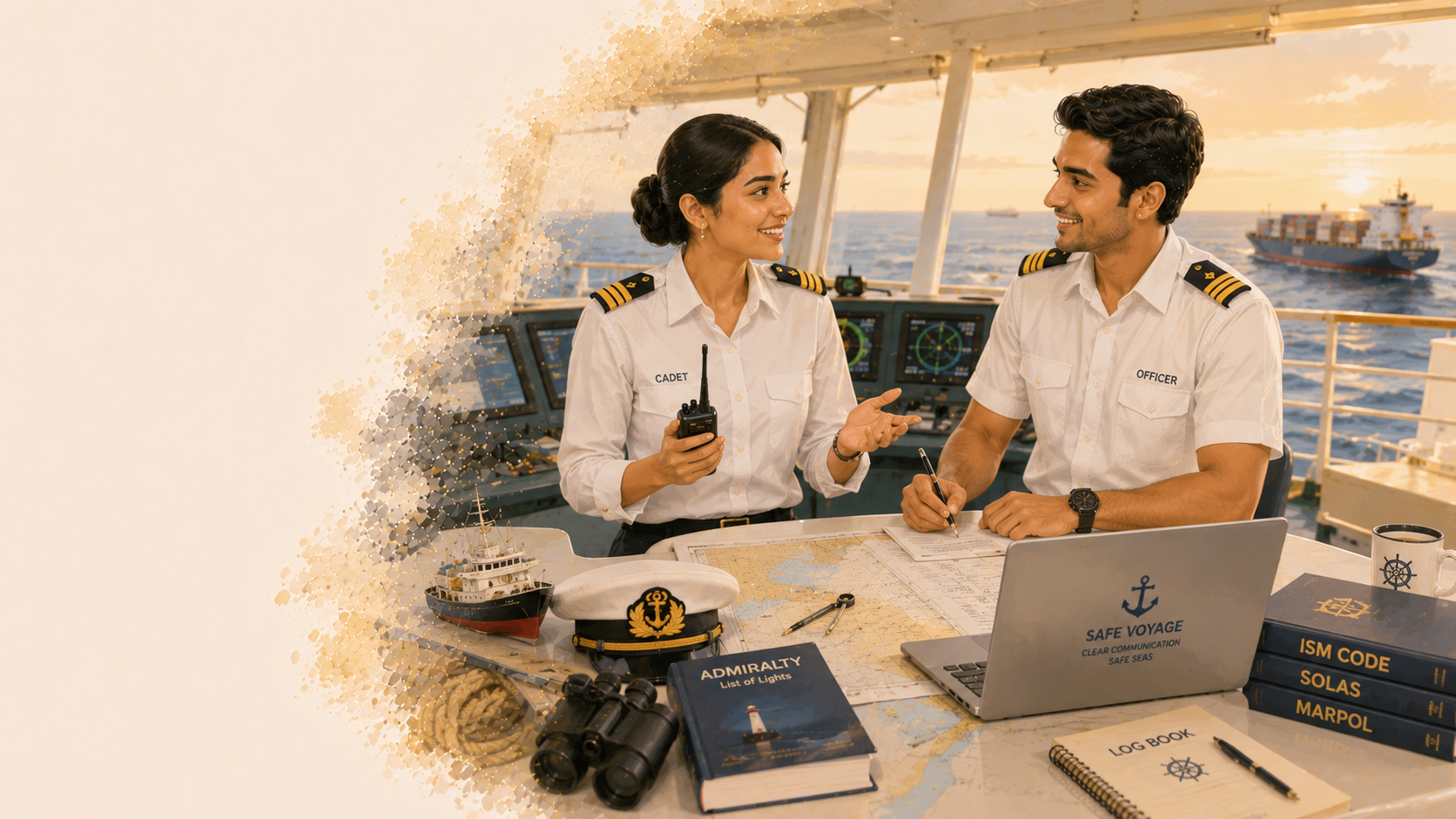
Maritime English Communication Training for Seafarer & Marine Institutes
In the maritime industry, English isn't preferred — it's mandated. Under the IMO's STCW Convention, English is the working language of the sea. The best berths on international vessels are closed to any cadet who can't communicate in it — precisely, instantly, under pressure.
- TESOL/TEFL certified trainers
- On-site or online
- Fortnightly reports
A cadet excels in every technical subject — navigation, marine engineering, safety procedures. Then the pre-sea assessment, or a company interview, tests spoken English in a simulated bridge scenario — and they struggle to respond clearly under pressure.
The gap isn't that your students don't know English. It's the gap between the English they know and the English the IMO standard — and an international shipping line — expects: clear, precise, and instant, in routine operations and in emergencies alike.
Why generic English training doesn't close the maritime gap
The maritime industry doesn't need fluent conversationalists — it needs operationally precise communicators. That's a fundamentally different skill, and no general English course teaches it.
Grammar, vocabulary & conversational fluency
Useful foundations — but they stop exactly where the bridge, the engine room, and the pre-sea assessment begin. Being able to hold a conversation is not the same as giving a clear bridge report under pressure.
Operational communication confidence
The ability to use SMCP with precision, take and confirm bridge commands without ambiguity, communicate clearly in an emergency, and perform in a company interview — all in the same standard, practiced register.
What maritime-specific English training actually covers
Five operational communication skills your cadets need on every vessel — built into every session.
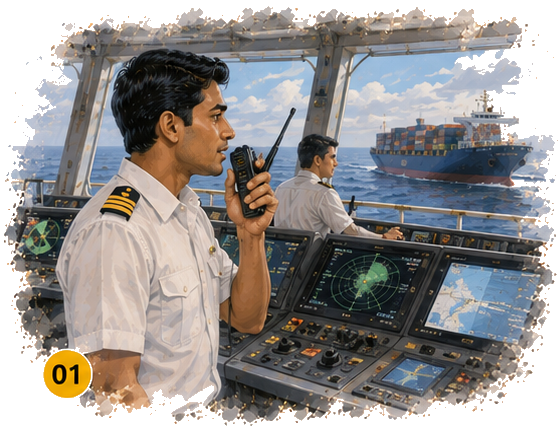
Standard Marine Communication Phrases
Use the standardised English phrases mandated by the IMO for shipboard and ship-to-shore communication — the precise, unambiguous language that prevents dangerous misunderstandings at sea. Fluency and confidence with SMCP is a baseline expectation on any international vessel, and it is directly assessed in pre-sea evaluations. A cadet who hesitates with SMCP is a cadet a shipping company will not place on their bridge.
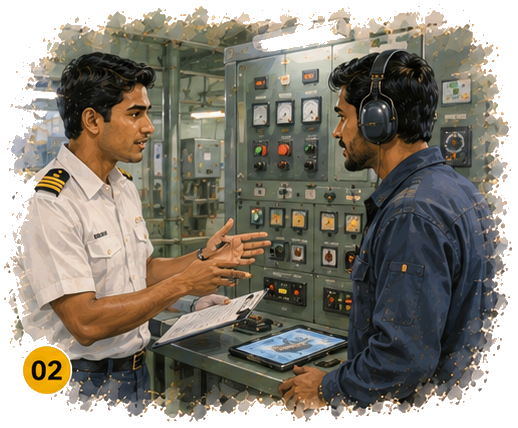
Bridge & engine-room command communication
Take and confirm commands, give clear reports, and communicate watch information precisely — where a misheard or unclear instruction is not an inconvenience but a safety risk. Cadets who are confident in this operational English register are immediately safer and more employable. The shipping companies that come to campus assess this directly, and students who have drilled it in context clear those assessments.
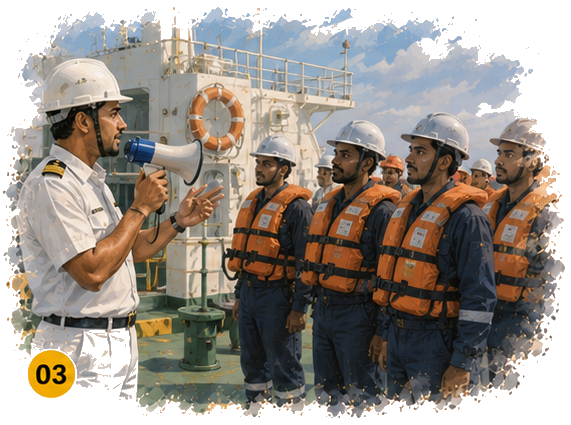
Emergency & safety communication
Communicate clearly during drills, alarms, muster, and emergency response — where clarity and speed are not a courtesy but the difference between a controlled situation and a disaster. International crews are assessed on whether every member can communicate in an emergency, regardless of nationality. MAYDAY, PAN-PAN, and SECURITÉ calls are part of the training — in the right format, in the right register, without hesitation.
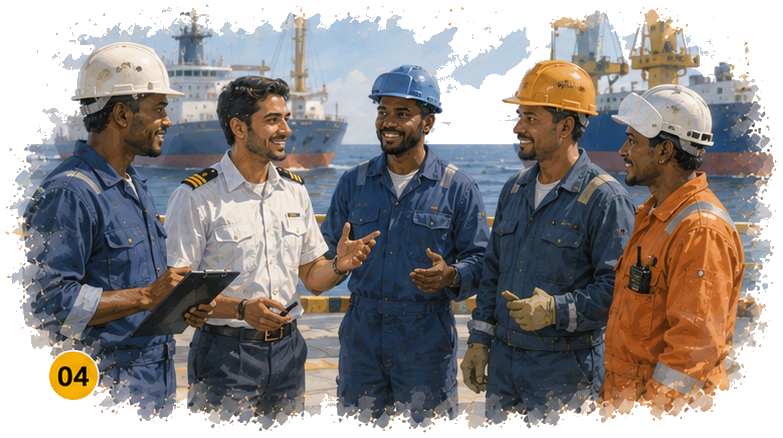
Multinational crew & daily shipboard communication
Coordinate tasks, work, and live alongside a crew from many countries — handling the everyday interaction that keeps a vessel running smoothly for months at sea. English is the common language, and a seafarer who can't participate confidently is isolated, overlooked, and less safe. Cadets who have practised the practical English of shipboard life integrate into international crews from day one.
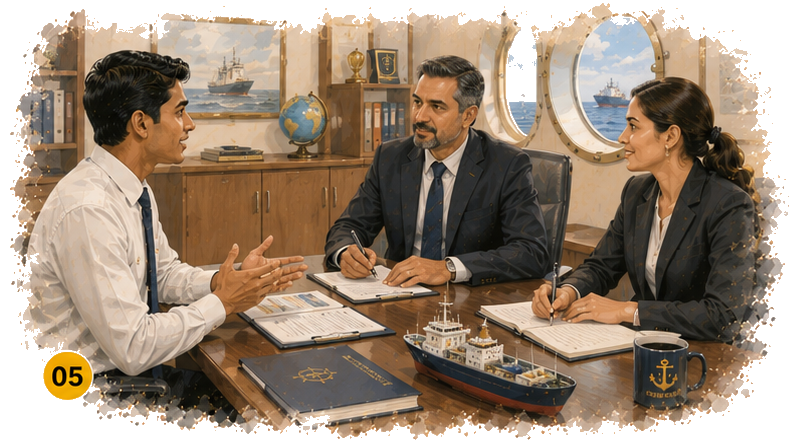
Company interviews & pre-sea assessment
Describe your training and experience, respond to scenario-based questions, and demonstrate spoken fluency under assessment conditions — the exact communication shipping companies and pre-sea assessments evaluate. Students who have practised in this register clear the interviews that lead to international berths. It is frequently the last filter between a technically qualified cadet and their first vessel.
Inside an Unpyn maritime session: What actually happens
Students are assigned real shipboard roles. The trainer takes the role of the senior officer or ship-to-shore station. The correction happens in the middle of something real.
What every session includes
- Bridge and engine-room simulations — cadets assigned real watch roles, trainer takes the captain or VTS station
- Emergency communication drills — MAYDAY, muster, and incident reporting in correct SMCP format
- Vocabulary in context — SMCP phrases, watch handover language, crew coordination — never from a list
- Mock assessments modelled on real pre-sea evaluations and company interview formats
- Practice sheets to reinforce each session between classes
- …and more, shaped around your institute's cadet profile and target shipping lines
A real example from the room
The scenario: A simulated bridge watch. The officer of the watch must report a developing situation — a vessel crossing ahead with reducing visibility — to the captain, clearly and using correct phrasing, while responding to instructions. Speed and precision both matter.
The cadet picks up the scene with the corrected, precise phrasing. When that same cadet sits in a simulator assessment or company interview, the standard, confident report is already a reflex.
Sample vocabulary — from the bridge to the interview room
Your students already have the technical training. Our job is to give them the English to prove it — in the simulator, on the bridge, and in the assessment room where berths are decided.
What this training delivers for your institute
The outcome your institute is measured on: placement rates on international vessels — not grammar scores.
Why The Unpyn Academy is the right partner for your maritime institute
Maritime English training at The Unpyn Academy is built entirely from STCW requirements and real shipboard scenarios — SMCP drills, bridge and engine-room simulations, emergency communication, pre-sea assessment formats — not adapted from a general spoken English course. Every role-play, every vocabulary set, and every exercise comes from what shipping companies and regulators actually assess. Our TESOL/TEFL certified trainers work as partners invested in your cadet placement outcomes.
STCW-aligned programme design
Built entirely from the operational English that IMO standards and shipping company assessments require — SMCP, bridge and engine-room communication, emergency protocols, and pre-sea interview English. Every exercise reflects a real standard, not a general proficiency target.
Flexible delivery, on-site or online
Group sessions for cadet batches and 1:1 coaching tracks for students who need additional support. On-site delivery is available exclusively for institutional programmes, scheduled around your academic calendar and pre-sea assessment windows.
Fortnightly progress reports
Every two to four weeks, a progress report covering individual and batch-level improvement is shared with your placement cell. Progress is measured and demonstrated — so you can see the change before your cadets sit their assessments.
Commercial flexibility for your institute
Programmes are priced per session or as a full semester or batch engagement, whichever fits your academic calendar and budget. Our focus is on one outcome: more of your cadets placed on international vessels.
Institutions we've trained

Ready to build a maritime English programme for your institute?
Tell us about your institute — the batch sizes, the shipping lines your cadets target, and where communication is limiting your placement outcomes — and we'll come back with a programme built specifically for your cadets.