
English Communication Training for Cabin Crew & Ground Staff
Airlines don't just hire on technical competence. They shortlist from academies whose graduates communicate with confidence from day one.
- TESOL/TEFL certified trainers
- On-site or online
- Fortnightly reports
A student aces every module of their cabin crew programme — safety procedures, service standards, emergency protocols. They walk into the airline placement interview, and freeze the moment the interviewer switches to English.
The gap isn't that your students don't know English. It's the gap between the English they know and the English airlines expect.
Why generic English training doesn't close it
A passenger dispute, a PA announcement, a baggage-claim escalation, an interview panel — each demands a register no general course teaches.
Grammar, vocabulary & conversational fluency
Useful foundations — but they stop exactly where the placement assessment begins. Knowing the words isn't the same as holding the conversation under pressure.
Situation-specific communication confidence
Handle a policy dispute, deliver a flight-delay announcement, manage a wheelchair-assistance request, and answer a panel question — all with the same composure.
What aviation-specific English training actually covers
Five communication situations your students will face in placement assessments and on the job — built into every session.

Airline interview & group discussion preparation
The exact register, vocabulary, and communication behaviours airline recruiters assess — how to introduce yourself, answer situational questions, and stay in the discussion when the language switches to English. Students who practise in this register perform measurably better at placement.

Passenger-facing complaint & conflict resolution
De-escalate, acknowledge, and offer solutions in English — specifically in aviation contexts. Not “how to be polite” but how to handle a passenger threatening to miss a connecting flight, how to explain a policy they disagree with, and how to close the interaction so the passenger feels heard even when the answer is no.
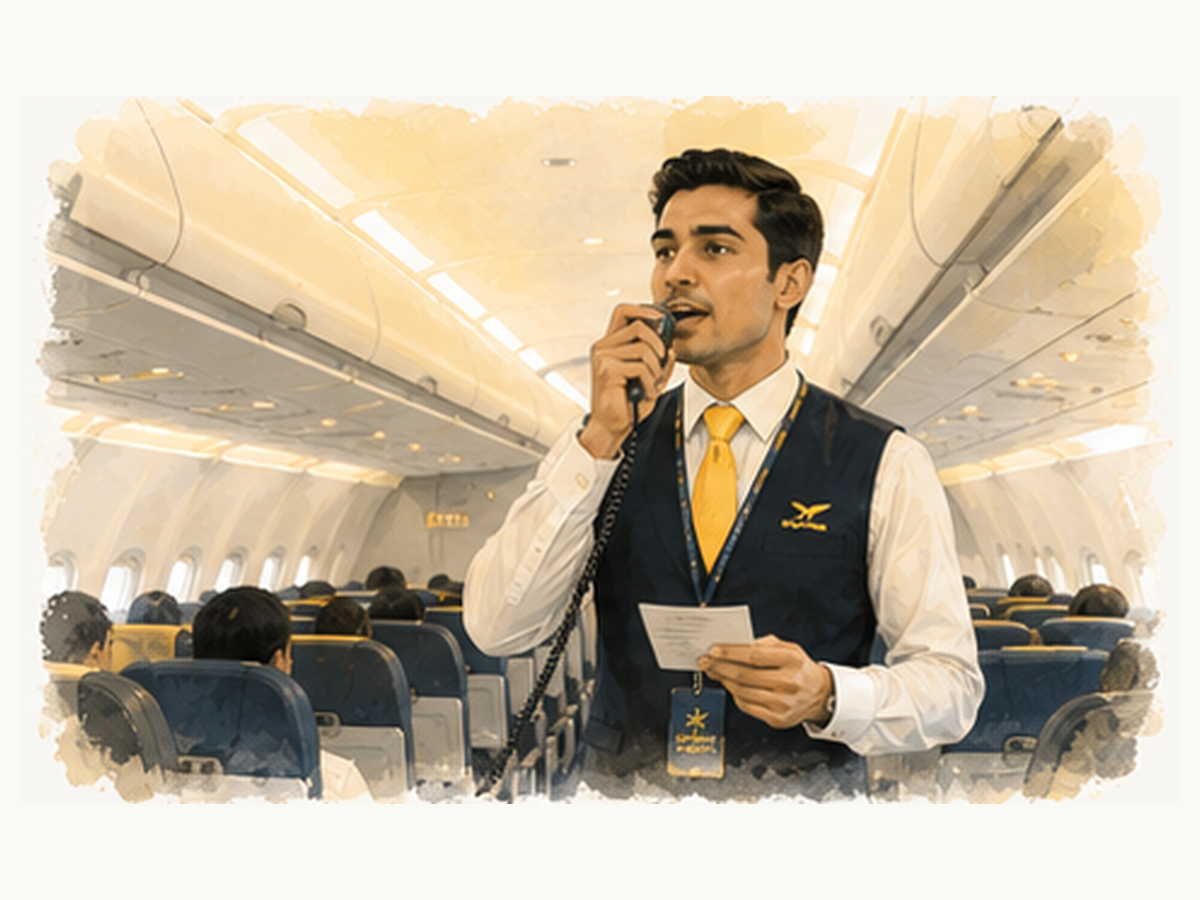
PA announcements & onboard communication
Clarity, pace, and confidence over an announcement system — where you can't see the audience, can't use body language, and have one chance to be understood. Welcome announcements, safety briefings, delay notifications, and emergency communication each carry their own register.
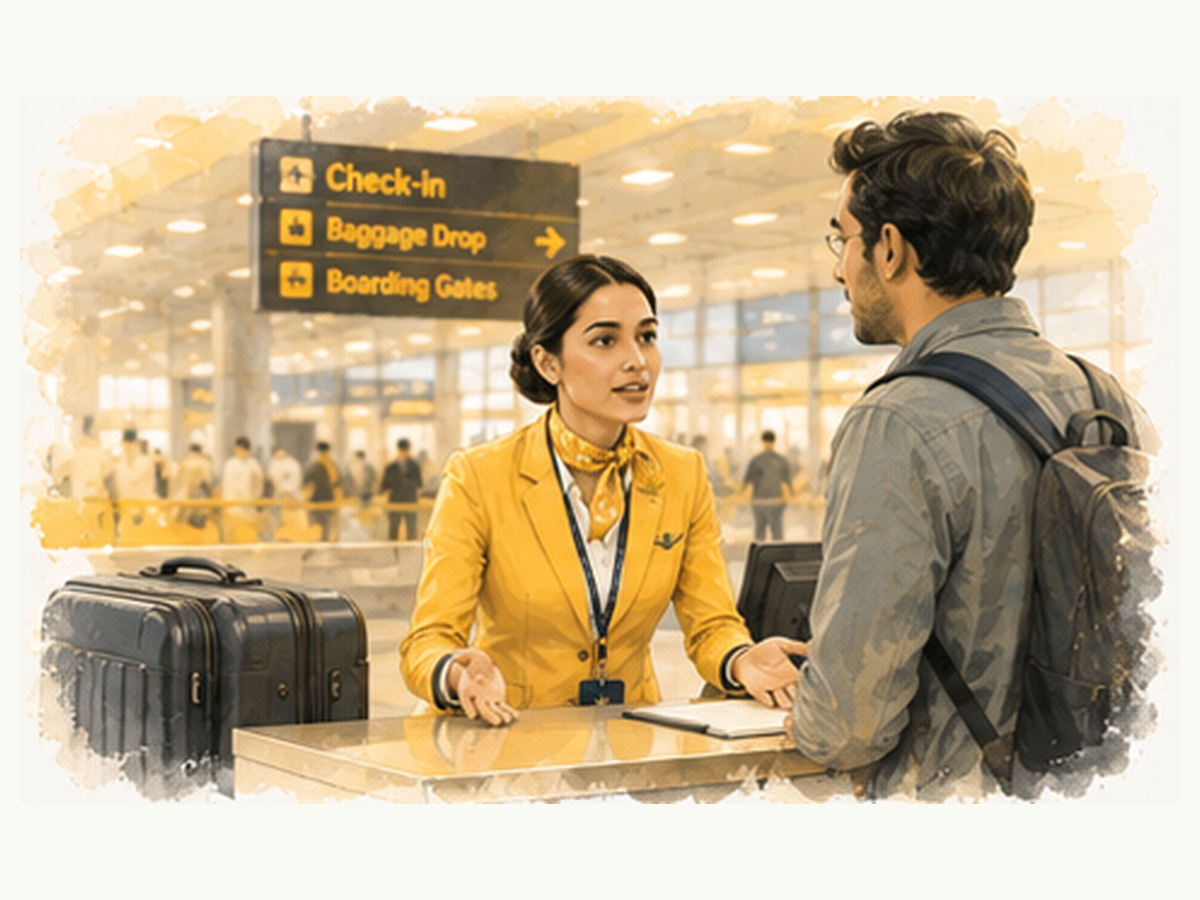
Check-in, baggage & boarding communication
The specific vocabulary and interaction scripts for check-in, excess-baggage handling, seat-upgrade offers, and boarding — including how to handle refusals, disputes, and escalations without becoming defensive or aggressive.
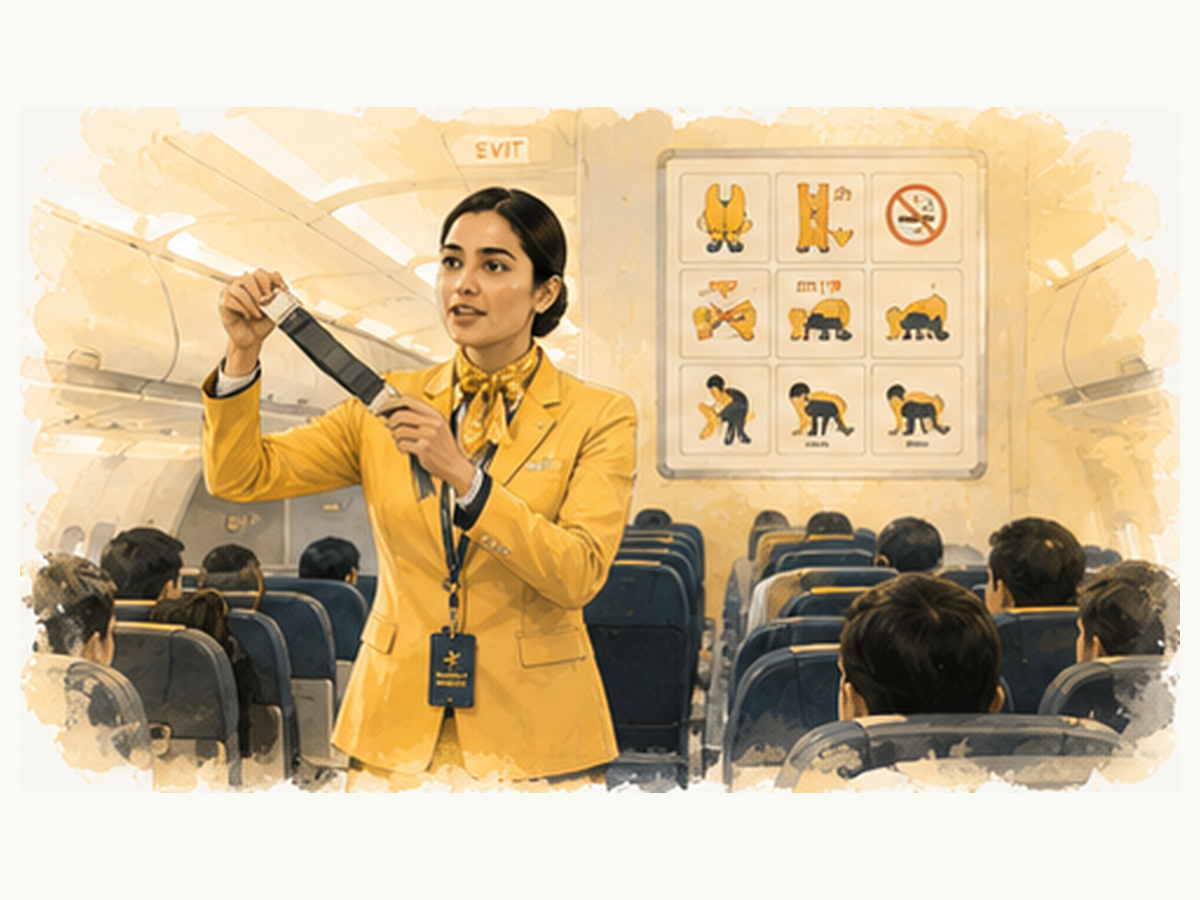
Emergency & safety communication
English for safety demonstrations, emergency-instruction delivery, and cross-crew communication — where clarity is a regulatory requirement, not a courtesy. Students confident in English safety communication perform better in airline drills and DGCA assessments.
Inside an Unpyn aviation session: What actually happens
Students take real job roles. The trainer plays the passenger. The correction happens in the middle of something real.
What every session includes
- Scenario-based role-plays drawn from real placement and on-the-job situations
- Real-life simulations — check-in counters, boarding gates, cabin announcements
- Vocabulary in context, never from a memorised list
- Mock tests modelled on airline interviews & group discussions
- Practice sheets to reinforce each session between classes
- …and more, shaped around your batch's specific gaps
A real example from the room
The scenario: A passenger arrives at check-in with 12 kg of excess baggage, refusing to pay, claiming they were told at booking it was included. They're getting louder. There's a queue behind them.
The student picks up the scene from that corrected line. Two weeks later, when a similar moment comes up in a real placement assessment, they don't freeze. They respond.
Sample vocabulary — straight from that one scenario
Your students may already know what excess baggage is. Our job is to give them the English to handle it under pressure — in context, not in theory.
What this training delivers for your academy
The outcome your academy is measured on: Students who get placed — not students who passed a grammar test.
Why The Unpyn Academy is the right partner for your aviation programme
Built entirely from aviation scenarios — not a business-English programme with airline vocabulary added. Every role-play and vocabulary set comes from the situations your students will actually face. Our TESOL/TEFL certified trainers work as partners invested in your placement outcomes.
Role-specific programme design
We build around the communication gaps of each role — cabin crew, ground staff, and operations — structured accordingly, not delivered as a one-size batch.
Flexible delivery, on-site or online
Group workshops for batches and 1:1 tracks for students who need more support. On-site delivery is available for institutional programmes, scheduled around your academic calendar — including daily sessions before placement drives.
Fortnightly progress reports
Every two to four weeks, a report goes to your placement head or academic director — covering individual and batch-level improvement. Value measured and demonstrated, not assumed.
Commercial flexibility for your institution
Priced per session or as a full semester or batch engagement — whichever fits your calendar and budget. Our focus is on one outcome: Your students getting placed.
Institutions we've trained


Ready to build an English programme for your aviation academy?
Tell us about your batch — the programme, the intake size, and where your students are struggling in placement assessments — and we'll come back with a programme built specifically for your academy.