Most PTE candidates treat Summarize Written Text as a minor task. A warm-up. One sentence — how long can it take?
Here's what they don't realise until they see their score breakdown: Summarize Written Text is the only task in the entire PTE exam that simultaneously affects two communicative skills scores — Reading and Writing. Get it right, and you lift both in one go. Get it wrong, and you pull both down at once. For most PTE candidates, this task deserves three times more preparation than it gets.
What Summarize Written Text Actually Is
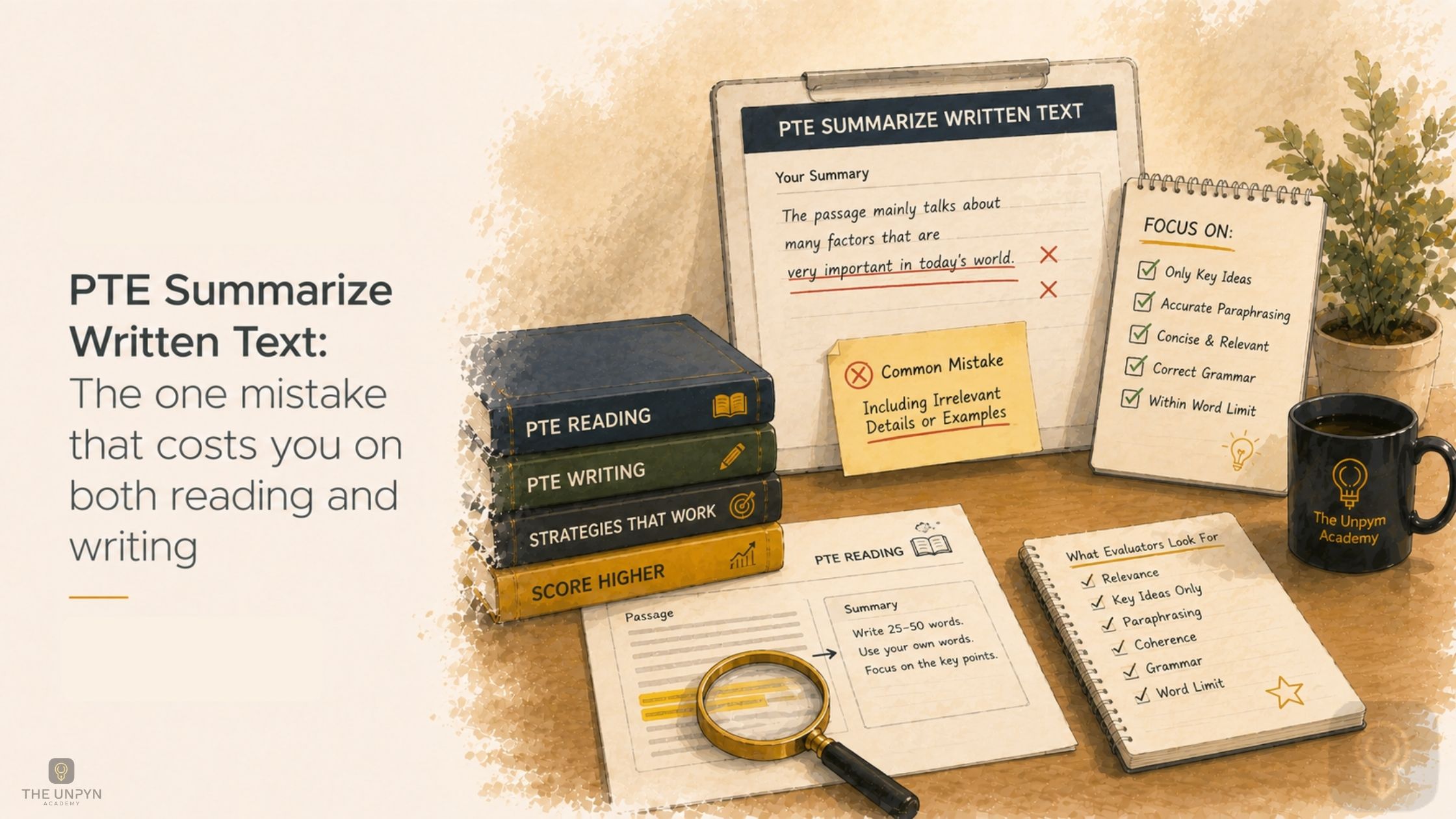
You're given a passage of up to 300 words. You have 10 minutes. Your job is to write a summary of that passage in a single sentence, between 5 and 75 words.
One sentence. That constraint is not a suggestion. It is a hard rule, and breaking it is the most common, most costly, and most entirely avoidable mistake in the task.
Why This Task Scores Both Reading and Writing
The Summarize Written Text task is scored under the Writing section, but Pearson's AI also uses it as evidence of your Reading ability. To write an accurate, complete summary, you must have understood the passage. If your summary misrepresents the main idea, it signals a reading comprehension failure — not just a writing one. If your summary is accurate and complete, it signals strong reading alongside strong writing.
This means every minute you spend getting better at Summarize Written Text pays off in two places on your scorecard simultaneously. And every mistake you make costs you twice.
The task is scored across four dimensions:
Content (0–2): Did you capture the main idea accurately and cover key supporting points?
Form (0–1): Is your response exactly one sentence, between 5 and 75 words, not written in all capitals?
Grammar (0–2): Is your sentence grammatically correct, with at least one main and one subordinate clause?
Vocabulary (0–2): Are your word choices appropriate? Did you paraphrase rather than copy directly?
The maximum score is 7 points. But here's the trap: Form is worth only 1 point, but if you fail Form, you score zero on everything. Every other dimension resets to zero the moment your response breaks the Form requirement.
The Mistakes, What They Are, Why They Cost You, What to Do Instead
Mistake 1: Writing Two Sentences
This is the most common mistake — and the most expensive. Two sentences means two full stops. The moment the AI counts a second full stop, your Form score drops to zero. A zero on Form means your entire response scores zero, regardless of how accurate or well-written it is.
The reason it happens: students understand the content, identify the main idea and supporting points, and then write two clean sentences because that's how they naturally express two connected ideas. The result is grammatically perfect, content-accurate, and scores nothing.
What to do instead: connect ideas using subordinate clauses and conjunctions. The key connectors are: which, where, that, while, although, because, and, but, whereas, suggesting that, indicating that. A strong SWT response looks like this:
Main clause + [which/that + supporting idea] + [while/although + contrast] + [suggesting/indicating + conclusion]
Mistake 2: Going Over 75 Words
Candidates who know they need to cover the main idea and multiple supporting points often overshoot the word limit. The AI word counter is precise. 76 words is a Form violation, and the entire response scores zero.
The safe target is 35–55 words. That's enough space to include the main idea and one or two key supporting points. Anything beyond 55 words is usually repetition or over-explanation. Write your response, count the words, and if you're above 55, identify what's non-essential and remove it.
Mistake 3: Copying Directly from the Passage
The AI detects copied phrases. Direct copying reduces your Vocabulary score because the task requires paraphrasing — showing that you understood the passage well enough to restate it in your own language. Key words, technical terms, proper nouns, and specific data can be carried across. But explanatory phrases and descriptive content should be restated in your own words.
Struggling with PTE Summarize Written Text? Let's look at your responses together and identify exactly what's costing you marks.
Talk to a TrainerThe practical test: if a phrase in your response is more than four or five consecutive words from the original passage, it probably needs to be paraphrased.
Mistake 4: Summarising a Supporting Detail Instead of the Main Idea
Content is scored on whether your summary captures the central argument — not whether it accurately describes one interesting paragraph. The main idea is almost always broader than any single example or statistic. You'll usually find it in the first or last sentence of the passage, or in the opening sentence of the final paragraph. Before you write, identify: what is the one thing this passage is arguing or explaining? Everything else is support for that claim.
Mistake 5: Writing Grammatically Simple Sentences to Stay Safe
Candidates nervous about grammar sometimes default to very simple sentence structures. The result is technically correct but scores low on Grammar — which rewards complexity alongside accuracy. Pearson's official guidance is explicit: the best responses usually consist of a main clause and subordinate clause. A sentence with no subordination scores lower than one of equivalent accuracy that demonstrates grammatical complexity. If you're comfortable with relative clauses (which, that, who), conditional clauses (if, unless), or concessive clauses (although, even though), use them.
Mistake 6: Not Leaving Time to Proofread
You have 10 minutes. Spend the first 2–3 minutes reading the passage and identifying the main idea and two key supporting points. Spend the next 5–6 minutes writing. Spend the final 1–2 minutes on three checks:
Word count. Is it between 5 and 75 words? Use the on-screen counter.
Full stops. Is there exactly one, at the very end? Any additional full stop is a Form risk.
Grammar and vocabulary. Subject-verb agreement. Tense consistency. Any directly copied phrase that should be paraphrased.
What a Strong Response Looks Like
Passage main idea: Urban green spaces have measurable positive effects on mental health, and cities that invest in parks and public greenery see lower rates of anxiety and depression among residents.
Weak response (Form violation — two sentences): Urban green spaces have a positive effect on mental health. Cities that invest in parks see lower rates of anxiety and depression. This is accurate. It is also two sentences. It scores zero.
Strong response (one sentence, 38 words): Research shows that urban green spaces have measurable positive effects on mental health, with cities investing in parks and public greenery recording lower rates of anxiety and depression among residents, suggesting that prioritising urban nature is a public health decision as much as an environmental one.
The Scoring Dimension Summary
| Dimension | What It Checks | Max Points | Dropped to Zero If... |
|---|---|---|---|
| Content | Main idea accuracy and coverage | 2 | Form fails first |
| Form | One sentence, 5–75 words, not all caps | 1 | Two sentences or word limit breach |
| Grammar | Correct structure, complexity | 2 | Form fails first |
| Vocabulary | Paraphrasing, word choice, synonyms | 2 | Form fails first |
| Total | 7 | All zero if Form fails |
How Much Time Should You Spend Preparing This Task?
More than you are now. Three to four practice responses per day, under timed conditions, with attention to word count and Form rules, will build the habit within two to three weeks. The sentence structure — main clause, subordinate clause, connective, brief implication — needs to become automatic enough that you're not thinking about it during the exam. You want your cognitive load during the task to be entirely on understanding the passage, not on remembering the rules.