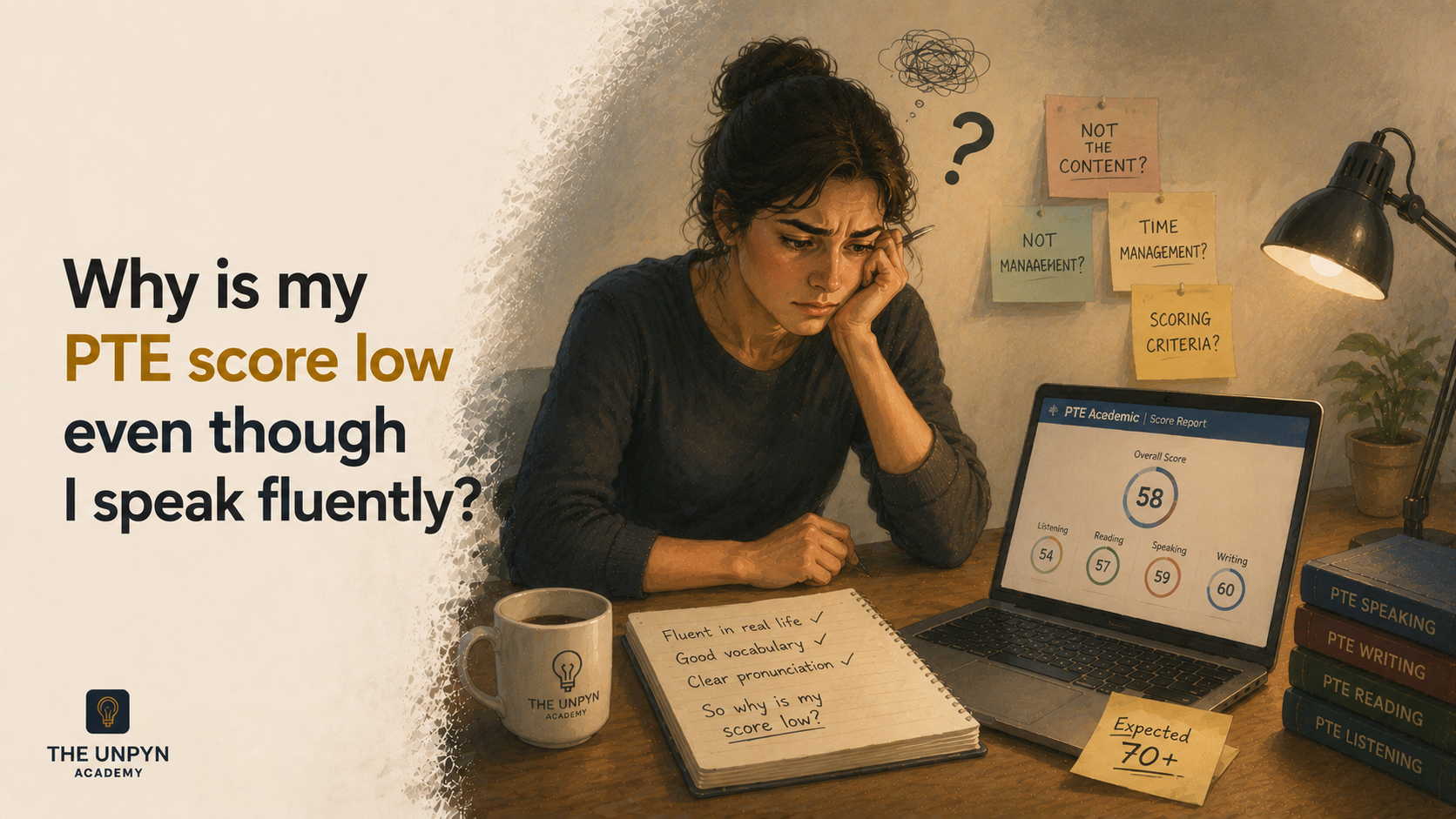
You speak English every day. At work, in meetings, on calls with international clients. You don't hesitate. You don't translate. You think in English.
And then you take PTE Academic and your Speaking score comes back at 65. Or 58. And the Enabling Skills breakdown tells you that your Oral Fluency is 62 and your Pronunciation is 59, and you have no idea how that's possible.
Here's the honest explanation — and it's not the one you want, but it's the one that will actually help you.
PTE Is Not Testing Whether You Can Communicate
IELTS Speaking has a human examiner. That examiner listens to you, follows your meaning, adapts to your accent, and judges whether you communicated effectively. They're trained to assess communication, not to parse your phonemes.
PTE Speaking has no human examiner. Pearson's AI-powered Versant technology analyses your speech patterns, stress placement, rhythm, and clarity in milliseconds. It is not following your meaning. It cannot be charmed by confidence or persuaded by content. It is measuring specific, quantifiable speech features against a trained model — and it scores what it detects, not what you intended.
This is why fluency in daily life does not automatically translate to a high PTE Speaking score. The AI is not your international client. It doesn't fill in gaps, tolerate approximations, or give credit for generally clear communication. It scores what it can measure.
Understanding what it measures — and what it doesn't — is the entire game.
The Two Scores That Control Your Speaking Band
PTE Speaking is assessed on three dimensions: Content, Oral Fluency, and Pronunciation. Content is about accuracy — did you say the right words in Read Aloud, repeat the right sentence in Repeat Sentence? Oral Fluency and Pronunciation are the two scores where fluent speakers consistently underperform — and they're worth understanding in detail.
Oral Fluency — It's Not What You Think
Oral Fluency does not measure how naturally you sound to a human listener. It measures the absence of specific speech disruptions that the AI is trained to detect:
- Hesitations (pauses filled with "um," "uh," or breath)
- Repetitions (repeating a word or phrase before continuing)
- False starts (beginning a word or phrase and abandoning it)
- Phonological simplifications (reducing consonant clusters or dropping sounds)
A score of 5 in Oral Fluency requires no hesitations, repetitions, false starts, or phonological simplifications. A score of 4 allows no more than one of each.
The reason fluent speakers are caught off guard by this: in real conversation, these micro-disruptions are entirely normal and barely noticed. Your listener's brain smooths over a hesitation or a brief repetition. The AI doesn't. It registers each one as a deduction.
Someone who speaks confidently at a slightly uneven pace — with natural conversational rhythm — may have more AI-detectable disruptions than someone who speaks more deliberately at a steady pace, even if the first person sounds more natural to a human ear.
This is the counterintuitive truth about PTE Oral Fluency: natural-sounding speech and high-scoring speech are not the same thing.
Pronunciation — What the AI Is Actually Checking
The AI is not comparing your speech to a native British or Australian speaker. It is checking whether your phonemes are recognisable, your stress is roughly correct, and your fluency markers are within an acceptable range.
For Indian speakers specifically, three patterns consistently reduce Pronunciation scores without the speaker noticing:
Consonant cluster simplification: English has words ending in multiple consonants — "text," "next," "facts," "tests." In Indian English, these are frequently simplified: "tex," "nex," "fac." The AI detects this as a phonological reduction and scores it accordingly.
Incorrect word stress: Multi-syllable words have a primary stressed syllable, and English rhythm depends on these stress patterns being roughly correct. Common misfires: "de-VEL-op-ment" instead of "de-VEL-op-ment" (that one is consistent), but words like "CON-tri-bute" vs "con-TRIB-ute," "AD-dress" vs "a-DRESS," or "RE-cord" vs "re-CORD" (noun vs verb distinction). Stress errors on common academic vocabulary accumulate across a task.
Vowel reduction in unstressed syllables: English naturally reduces unstressed vowels to a schwa (the "uh" sound in "about," "taken," "syllable"). Indian English frequently preserves full vowel sounds in unstressed syllables, which the AI registers as diverging from the expected phonological pattern.
None of these is "wrong" in any meaningful linguistic sense. They're features of Indian English as a dialect. But PTE's Versant AI is trained on a specific model of pronunciation features, and these patterns consistently produce lower Pronunciation scores.
The AI Scoring Traps — Specific to Each Task
Read Aloud
This is the highest-impact task in PTE Speaking — it simultaneously scores Reading and Speaking, contributing to both communicative skill scores. And it's where the specific failure mode of fluent speakers shows up most clearly.
Fluent speakers rush Read Aloud. They see a text, they can read it quickly, and they do — at a pace that produces more Oral Fluency disruptions (because the brain is processing ahead of the voice) and more Pronunciation compressions (because speed reduces phoneme precision).
A steady, natural pace scores far better than a hurried read-through. Slower is higher-scoring in Read Aloud — not because slow sounds better to a human, but because a steady pace produces fewer AI-detectable disruptions.
Repeat Sentence
This task tests working memory and oral production simultaneously — you hear a sentence of 8–13 seconds and must repeat it exactly. Fluent speakers often fail here not because they can't produce the sounds, but because they reconstruct the sentence from meaning rather than repeating it verbatim.
"The government has introduced new regulations affecting small businesses" becomes "The government introduced new regulations for small businesses" — close, but two word-level errors. Errors in word choice or sentence structure cost Content points in Repeat Sentence. The AI does not give partial credit for approximate reproduction.
Describe Image
Fluent speakers often go off-structure in Describe Image — they have a lot to say and they say it. The issue is the AI is scoring Oral Fluency across the entire response, and a less structured but longer response introduces more disruption opportunities than a tight, structured 25–35 second response.
The high-scoring Describe Image response follows a template: overview of what the image shows, identification of the key data point or trend, brief implication. Consistent, structured, and within the time limit. Attempting to describe everything you see produces a longer, less fluent response that scores lower than a shorter, more controlled one.
Re-tell Lecture
Re-tell Lecture contributes to both Speaking and Listening scores — strong performance can lift multiple skills at once. The trap for fluent speakers: they listen too broadly, try to retain too much, and produce a dense, slightly disorganised spoken summary. The AI penalises the organisational inconsistency through Oral Fluency, not for content inaccuracy.
The fix: listen for three things (main topic, main point, example or implication). Structure the response in that order. Predictable structure produces fluent delivery.
Why Self-Correction Is the Most Expensive Habit
Never self-correct. Keep moving forward even if you make a mistake.
This is one of the most counterintuitive PTE Speaking rules, and one of the most important. When you self-correct mid-sentence — "The company has, I mean had, a significant..." — you've introduced a repetition and a false start. The AI scores both as Oral Fluency deductions.
If you mispronounce a word or say the wrong one, continue. The single error costs less than the repair.
This feels wrong to every fluent speaker who has learned that precision matters. In PTE Speaking, the disruption of correction costs more than the original error.
The Enabling Skills Score and What It's Telling You
PTE scores are reported across Enabling Skills — Grammar, Oral Fluency, Pronunciation, Spelling, Vocabulary, and Written Discourse — in addition to Communicative Skills. These enabling scores reveal specifically where your communicative scores are being limited.
If your Speaking communicative score is lower than your performance in Reading tasks, look at your Oral Fluency and Pronunciation enabling scores. If either is below 65, that's your ceiling. You can practise Speaking tasks indefinitely without improving your communicative score if the enabling skill pulling it down remains unchanged.
The enabling skills score is not a general measure of your English. It's a diagnostic of which specific AI-evaluated feature needs work. Use it.
The Preparation Shift That Actually Changes Scores
General English practice does not improve PTE Speaking scores. The AI does not reward generally better English — it rewards the absence of specific patterns it detects as disruptions.
The preparation that works: practice on a platform that evaluates responses against the same rubric PTE uses — showing Oral Fluency, Pronunciation, and Content scores per response per task, not just overall feedback. Recording yourself on your phone tells you what you sound like. It does not tell you what Versant is detecting.
Targeted phoneme work on the specific sounds that consistently score low. Deliberate pace control on Read Aloud — practised until slower feels natural. Template discipline on Describe Image and Re-tell Lecture. And a deliberate no-self-correction habit built through timed practice until continuing through errors is automatic.
These are specific changes, not general improvements. They're why someone who has been "practising PTE" for three months without score movement often moves significantly within two to three weeks of preparation that targets the AI's specific detection patterns.