Your PTE results arrived. There are a lot of numbers on the page.
An overall score. Four communicative skill scores. Six enabling skill scores. You know the overall number you needed. You may or may not have hit it. But the rest of the report — the breakdown that's supposed to tell you what went well and what didn't — looks like it needs its own explanation.
This is that explanation.
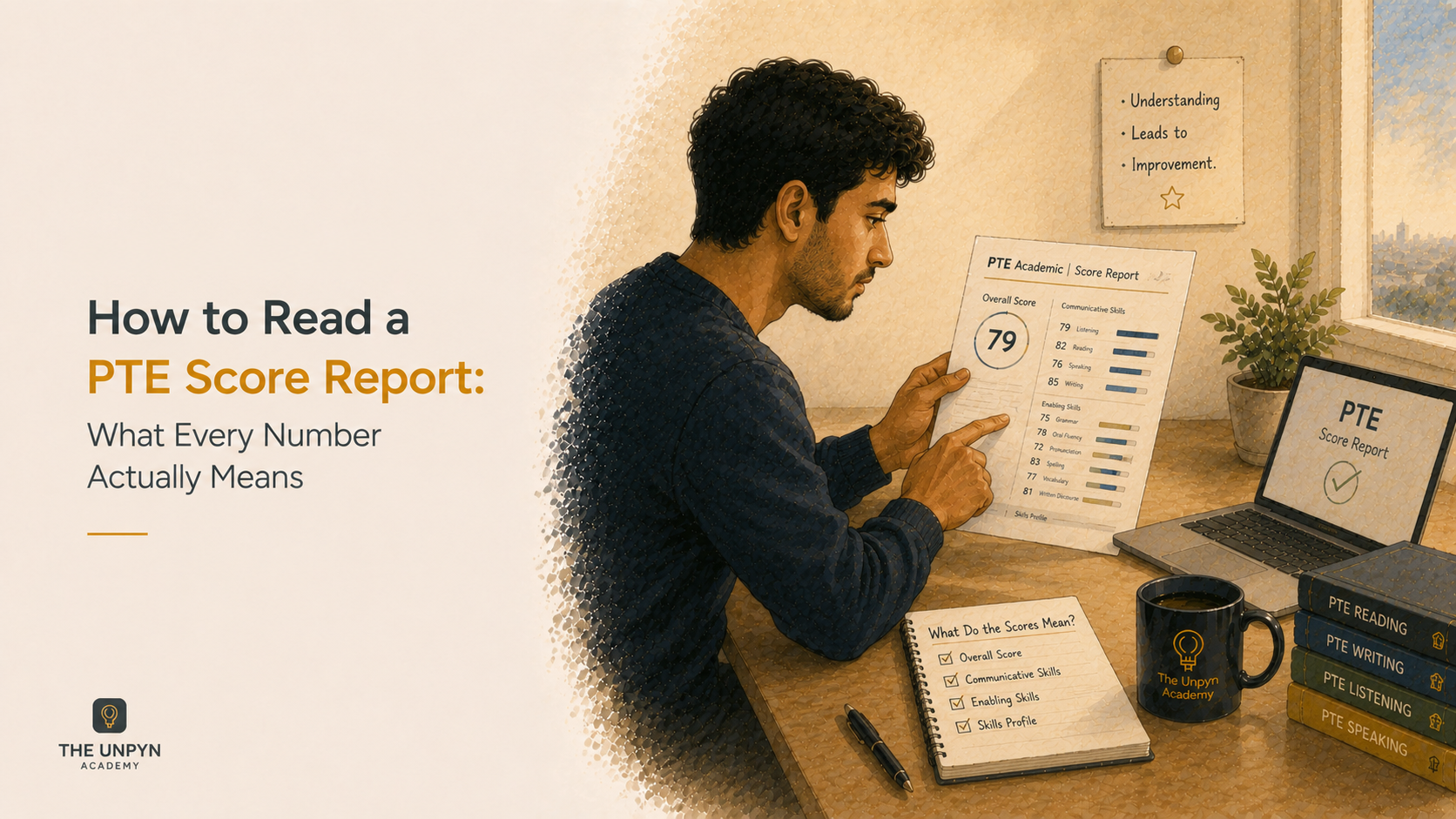
The Three Layers of a PTE Score Report
PTE Academic reports three categories of scores:
- Overall Score — a single number from 10 to 90 2. Communicative Skills Scores — four scores, one for each skill: Listening, Reading, Writing, Speaking 3. Enabling Skills Scores — six scores that underpin your communicative skills
Understanding how these three layers relate to each other is the key to using your score report as a diagnostic tool rather than just a result.
Layer 1: The Overall Score
The overall score is a weighted average of your communicative skill scores. It sits on a scale of 10 to 90 and is the number most institutions and visa authorities use to assess your eligibility.
It is not a simple average of the four communicative skill scores. Pearson uses a weighted algorithm that accounts for the spread of tasks across all four skills, so the overall can be slightly higher or lower than the arithmetic mean of the four communicative scores.
Most requirements are expressed as an overall score minimum, sometimes with minimum component scores alongside. If your overall score meets the requirement but a component score doesn't, you may still fail to qualify — so always check the full requirement, not just the headline number.
Layer 2: Communicative Skills Scores
These are your four individual skill scores — Listening, Reading, Writing, Speaking — each on a scale of 10 to 90.
These scores reflect your performance across all tasks that contribute to each skill. Some tasks contribute to a single skill; others contribute to two simultaneously (integrated tasks — see below).
Integrated Task Contributions
This is the part of PTE scoring most candidates don't fully understand:
- Read Aloud → contributes to both Speaking and Reading
- Repeat Sentence → contributes to both Speaking and Listening
- Re-tell Lecture → contributes to both Speaking and Listening
- Summarize Written Text → contributes to both Writing and Reading
- Write from Dictation → contributes to both Writing and Listening
This matters because strong performance on an integrated task lifts two communicative scores at once — and weak performance on one drags two scores down simultaneously. If your Speaking and Listening are both lower than expected, your Repeat Sentence or Re-tell Lecture performance is the first place to look.
Layer 3: Enabling Skills Scores
This is the most misunderstood part of the PTE score report — and the most useful for diagnosis.
Enabling Skills are the sub-skills that underpin your communicative performance. PTE scores are reported on a detailed 10–90 scale, and Enabling Skills — Grammar, Oral Fluency, Pronunciation, Spelling, Vocabulary, and Written Discourse — support your communicative scores but aren't assessed as separate requirements.
Here's what each Enabling Skill measures:
| Enabling Skill | What It Measures | Affects These Communicative Skills |
|---|---|---|
| Oral Fluency | Smoothness, pace, and absence of hesitations in speech | Speaking |
| Pronunciation | Phoneme accuracy, word stress, intelligibility | Speaking |
| Grammar | Accuracy and range of grammatical structures | Speaking, Writing |
| Vocabulary | Range, accuracy, and appropriateness of word choice | Speaking, Writing |
| Spelling | Accuracy of written word forms | Writing, Listening |
| Written Discourse | Coherence, structure, and development of written responses | Writing |
Why Enabling Skills Are the Most Important Numbers on Your Report
Your Enabling Skill scores tell you why your communicative scores are at the level they are.
Two candidates can both have Speaking 65. One has Oral Fluency 72 and Pronunciation 58. The other has Oral Fluency 55 and Pronunciation 70. Their Speaking scores are the same, but the preparation they need is completely different. The first needs Pronunciation work. The second needs Oral Fluency work.
The communicative score tells you where the problem is. The enabling score tells you what the problem is.
If you're preparing for a retake, your enabling scores are your preparation roadmap.
Reading Your Report: A Worked Example
Let's say your score report looks like this:
- Overall: 63
- Listening: 71 · Reading: 68 · Writing: 58 · Speaking: 61
- Oral Fluency: 62 · Pronunciation: 59 · Grammar: 65 · Vocabulary: 68 · Spelling: 71 · Written Discourse: 55
What does this tell you?
Writing is the lowest communicative score (58). The enabling skills pulling it down are Written Discourse (55) and Oral Fluency/Pronunciation (which affect Speaking, not Writing directly). Written Discourse at 55 tells you the structure and coherence of your written responses — likely your essays — is weak. Not vocabulary (68), not spelling (71). Structure.
Speaking is also below par (61). Pronunciation at 59 is the specific enabler causing the issue — not fluency (62), which is borderline acceptable.
The preparation for this candidate is: Written Discourse (essay structure and coherence) for Writing, and Pronunciation specifically for Speaking. Not general English improvement. Not vocabulary. Two specific, targeted issues.
What to Do With This Information
Step 1: Find your two lowest enabling skill scores.
Step 2: Match them to the communicative skills they affect (use the table above).
Step 3: Confirm those communicative skills are the ones pulling your overall score down.
Step 4: Build your retake preparation around those specific enabling skills — not general practice across all tasks.
If your Oral Fluency is below 60, the fix is pace control and hesitation reduction — not more vocabulary. If your Written Discourse is below 60, the fix is essay structure — not grammar drills. If your Spelling is below 65, the fix is targeted word list work — not Speaking practice.
The enabling skills scores make your preparation precise. Use them.
The Score Report for AHPRA (April 2026 Update)
If you're using PTE for AHPRA healthcare registration in Australia, note the updated April 23, 2026 requirements:
- Speaking minimum increased from 66 to 76
- All other communicative skill minimums remain at 65
If your score report shows Speaking at 70 — which previously would have met AHPRA's requirement — it no longer does under the new threshold. Check your test date against the April 23, 2026 cutoff to confirm which requirements apply to your results.