The visa deadline is visible. The PTE registration window is open. You have roughly 21 days between now and when you need a score report in hand.
And you speak English reasonably well — not perfectly, but functionally. You communicate at work. You read and write without struggle. You're not starting from zero.
Can it be done? The honest answer: for the right candidate, yes. For the wrong candidate, three weeks is not enough — and the difference between those two people is specific and diagnosable.
The Honest Baseline Check
Before strategy, a single question: what does your current English level actually look like against the PTE scoring scale?
If you've never taken a PTE mock test, take one before reading any further. A timed full-length mock under real conditions gives you the only data point that matters — not where you feel you are, where the test puts you.
Three weeks is realistic if your mock test baseline is:
- Overall 55–65 targeting 65+
- Strong in two or three skills, with one specific weak section pulling you down
- Communicative skill gaps rather than Enabling Skill gaps (see below)
Three weeks is not enough if:
- Your baseline is below 50 overall
- Multiple skills are weak by more than 15–20 points from your target
- Your Oral Fluency or Pronunciation Enabling Skills scores are below 55 (these take longer to fix than technique-based gaps)
- Your target is 79+ for AHPRA or a highly competitive institution
This is not about motivation or work ethic. It's about what the preparation actually requires. An Oral Fluency gap closes through habit change — and habits don't change in three weeks unless you're practising multiple hours daily with AI feedback. A task-technique gap — not knowing the format or structure of Describe Image — closes in a few days.
Know which type of gap you have before you commit to the timeline.
How PTE Scoring Works (The Part That Makes Three Weeks Possible)
PTE Academic is scored differently from IELTS, and this difference is what makes a three-week improvement actually achievable for the right candidate.
Every task in PTE is scored by AI against specific, measurable criteria. The scoring is consistent — the same response will receive the same score every time. There are no examiner variables, no subjective judgements, no good or bad days on the other side of the assessment.
This means the scoring criteria are learnable. Once you understand what the AI is detecting in each task, your preparation becomes precise rather than vague. You're not "improving your English" — you're removing the specific patterns the AI penalises, and adding the specific structures it rewards.
The tasks that gain points fastest are the ones where the gap between your current behaviour and the correct technique is largest, and where the technique is the simplest to change.
The High-ROI Tasks: Where Three Weeks of Focused Work Pays Most
Read Aloud (Speaking + Reading)
Read Aloud is the highest-value task in PTE. It simultaneously contributes to your Speaking and Reading communicative scores, which means strong performance here lifts two scores at once.
The technique that unlocks it: slow down, stress key words, pause at punctuation. Most candidates rush Read Aloud because they can read the text quickly. Rushed delivery produces Oral Fluency deductions. A steady, deliberate pace — slightly slower than conversational speech — produces clean Oral Fluency and allows Pronunciation accuracy. Three to five days of focused Read Aloud practice with timed delivery at a controlled pace produces measurable score improvement on one of the most heavily weighted tasks.
Repeat Sentence (Speaking + Listening)
Repeat Sentence contributes to both Speaking and Listening. Unlike many tasks, it requires no preparation of content — just the ability to retain and reproduce a sentence accurately.
The technique: chunking. Rather than trying to remember every word sequentially, break the sentence into two or three meaningful phrases as you listen. "The government / has announced new measures / to address climate change." Reconstruct phrase by phrase, not word by word. Candidates who practise chunking for five to seven days typically see significant score improvement on this task.
Summarize Written Text (Writing + Reading)
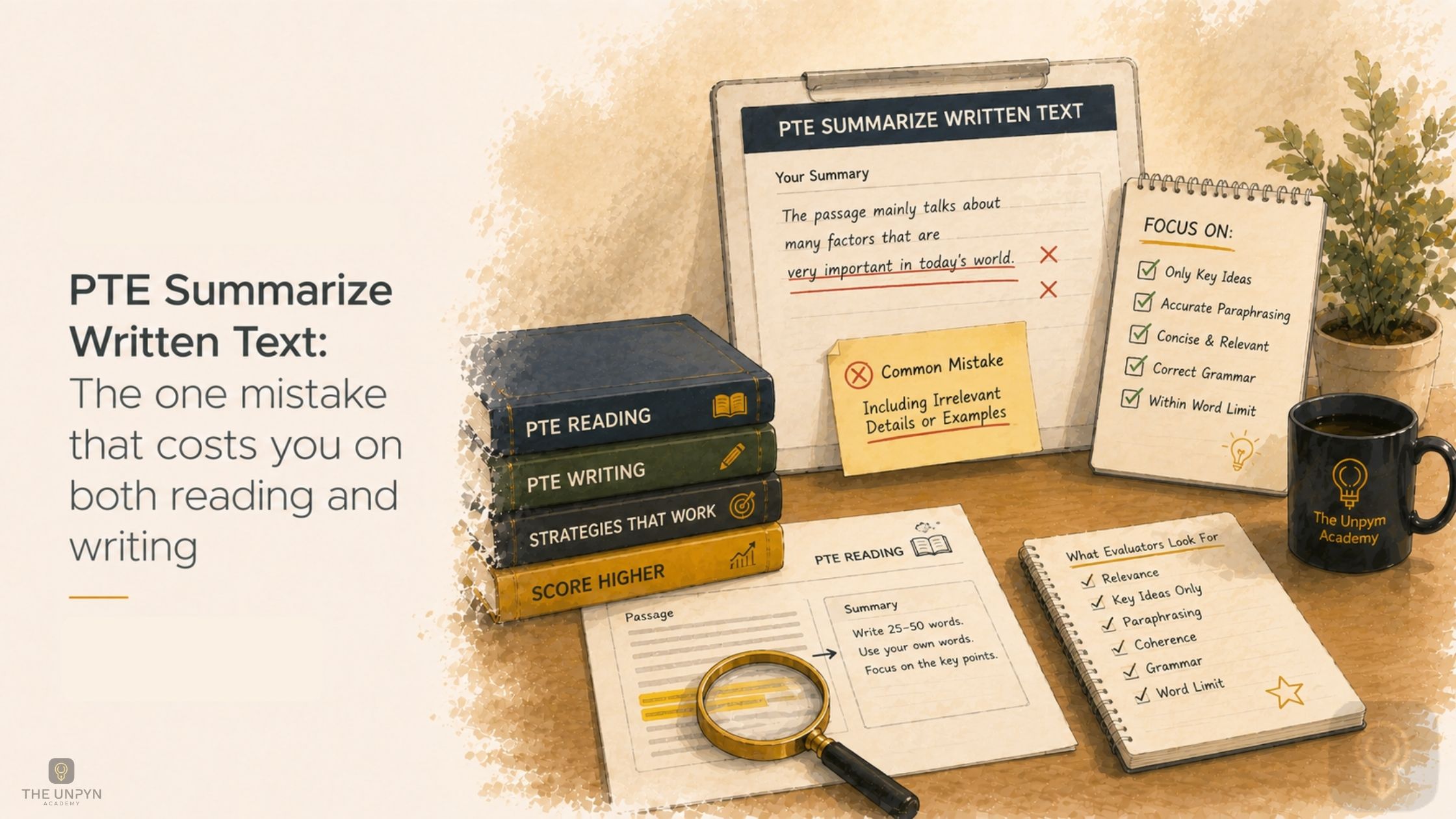
This task — covered in detail elsewhere on this blog — simultaneously scores Writing and Reading. One sentence, 5–75 words. The most common mistake: writing two sentences and receiving zero across all criteria.
The fix is a one-day learning investment: understand the Form rule (one sentence, hard limit), learn the sentence structure (main clause + subordinate clause + connective + implication), and practise until the constraint feels natural rather than limiting. Three weeks is more than enough to master this task format completely.
Write Essay (Writing)
Write Essay is assessed across four traits in 2026: Content, Development, Structure & Coherence, and Linguistic Range — each rated on a 0–6 scale. For candidates with decent English, the low-hanging fruit is Structure & Coherence — a clear introduction, two developed body paragraphs, and a conclusion. Candidates who haven't written formal essays recently benefit disproportionately from a few days of structured essay practice, because the trait scoring directly rewards organisational predictability.
Avoid: highly templated essays that the AI flags as memorised. The 2026 scoring update specifically penalises unnatural patterns and overly robotic structures.
Fill in the Blanks — Reading and Writing
Often underestimated, the two Fill in the Blanks tasks are high-frequency, objectively scored, and highly trainable. Reading Fill in the Blanks tests contextual vocabulary — which word fits grammatically and semantically. Reading and Writing Fill in the Blanks tests both. One week of vocabulary-in-context practice specifically on collocations and academic word families produces consistent improvement on these tasks.
The Enabling Skills That Move Fastest
PTE Enabling Skills — Grammar, Oral Fluency, Pronunciation, Spelling, Vocabulary, Written Discourse — sit beneath your Communicative Skill scores and determine their ceiling.
In three weeks, you cannot meaningfully move a Pronunciation Enabling Skill score that's at 50. You can meaningfully move Grammar (through specific error pattern identification and targeted practice), Spelling (through a focused academic word list with timed writing), and Written Discourse (through structured essay practice).
If your Speaking communicative score is low because of Oral Fluency or Pronunciation, three weeks is a tight window. If it's low because you're rushing tasks or not following structure, three weeks is generous.
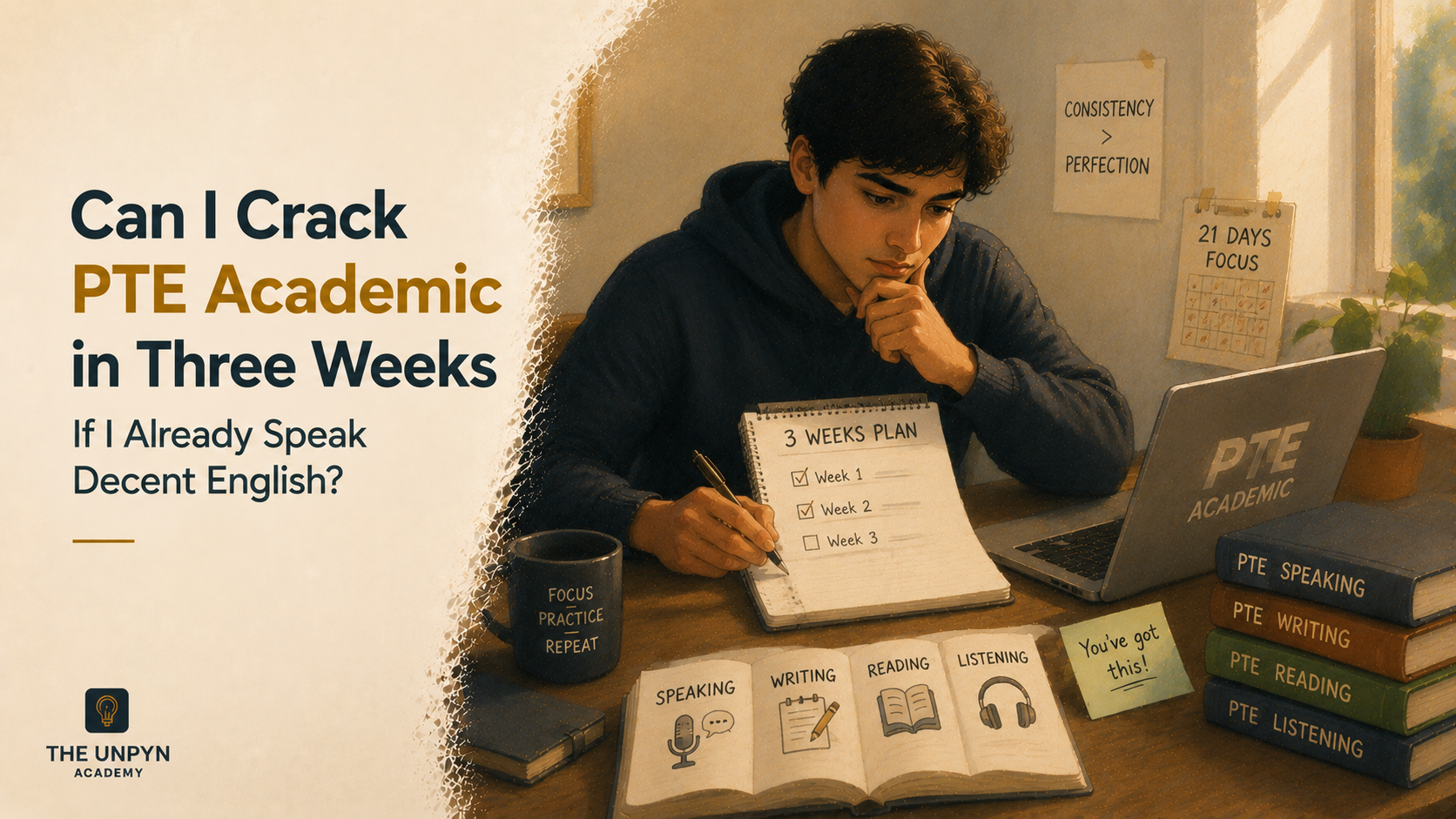
The Three-Week Sprint Plan
This plan assumes: baseline mock test completed, overall 55–65, target 65–75, gaps identified.
Week 1 — Task Mastery and Enabling Skill Diagnostics
Days 1–2: Review your mock test results. Identify your two lowest communicative skill scores and your two lowest enabling skill scores. These four numbers determine everything you do for the next three weeks.
Days 3–4: Learn the correct technique for Read Aloud and Repeat Sentence. Practise both daily with timed delivery. Do not move on until the pace and structure are automatic.
Days 5–6: Learn the Summarize Written Text one-sentence rule and practice structure. Complete five practice responses. Count words on every one.
Day 7: Take a second timed mock test. Compare scores. Where did you improve? Where didn't you? Adjust the remaining two weeks accordingly.
Week 2 — High-ROI Writing and Listening Focus
Days 8–10: Write Essay. Three timed essays on different prompt types. Focus on Structure & Coherence. Each essay should have an identifiable introduction, two developed paragraphs, and a conclusion. Review against the four traits.
Days 11–12: Listening practice — Summarize Spoken Text and Select Missing Word. These are objectively scored and highly trainable with daily practice.
Days 13–14: Fill in the Blanks (both types). Academic vocabulary in context. Spelling accuracy. Thirty minutes daily, focused review of every error.
Week 3 — Integration and Simulation
Days 15–17: Speaking integration. All five Speaking task types in sequence, timed. No self-correction. Steady pace on Read Aloud. Chunking on Repeat Sentence.
Days 18–19: Full-length mock test under real conditions. Review the score breakdown by enabling skill.
Days 20–21: Target the specific tasks your week 3 mock shows are still below target. Not broad review — the two or three question types with the most remaining gap.
One More Thing Worth Knowing
PTE Academic results are available in 1–2 business days, processed every day including weekends. This means if you take the test on a Thursday and need the score by the following Monday, you almost certainly have it.
The combination of short preparation window and fast results makes PTE genuinely attractive for visa-deadline situations. But the preparation still has to happen. A rushed three weeks of unfocused practice produces the same result as no preparation — which is why the specificity of the sprint plan above matters more than the intensity.