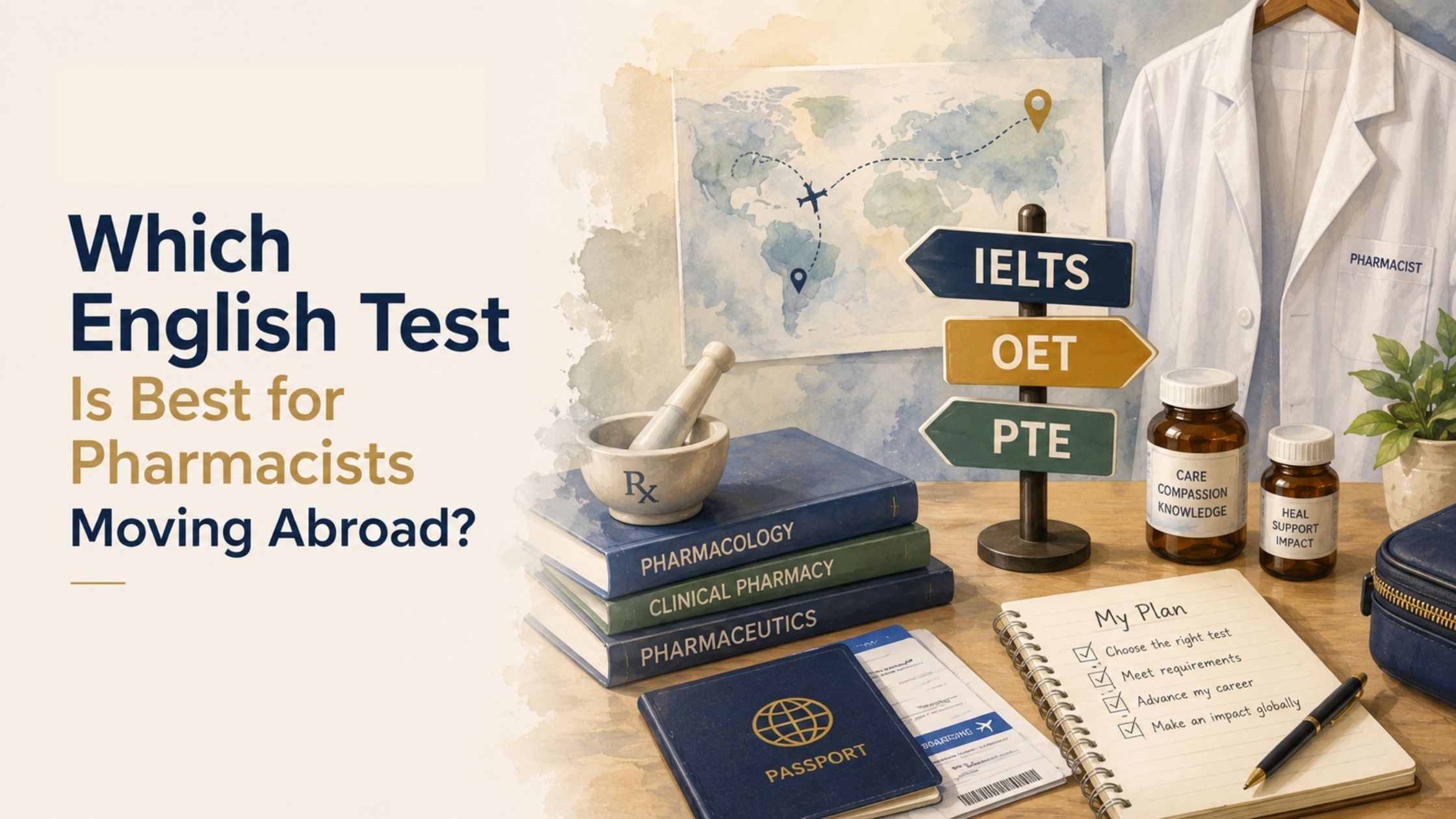
Pharmacy is one of the most globally mobile healthcare professions. The qualification is recognised across borders, the demand is consistent in the UK, Australia, Canada, New Zealand, and the Gulf, and the immigration pathways are well-established.
But before any of that moves forward — before KAPS, before PEBC, before AHPRA, before GPhC, before any licensing exam — there is an English proficiency test standing between you and registration in your destination country. And the answer to "which test should I take?" is not the same for every pharmacist going everywhere. It depends on where you're going, what the regulatory body requires, and what the visa pathway demands alongside the registration pathway. This is the complete guide.
The Key Distinction: Registration Test vs. Visa Test
Before anything else, understand that for most pharmacists moving abroad, there are two English language requirements to satisfy — not one.
Registration requirement: The pharmacy regulatory body in your destination country requires proof of English proficiency before granting registration to practise. This is about clinical competence and patient safety.
Visa requirement: The immigration authority requires proof of English proficiency to grant the work or skilled migration visa. This is separate from registration.
Sometimes one test satisfies both. Sometimes you need two different tests. Getting this wrong costs months and significant money.
United Kingdom — GPhC Registration
The General Pharmaceutical Council (GPhC) accepts: IELTS Academic (minimum Band 7.0 in each skill, single sitting); OET (Pharmacy) (minimum Grade B / 350 in each sub-test); TOEFL iBT and PTE Academic (verify current scores at pharmacyregulation.org).
Does the Test Also Cover Your UK Visa?
Not automatically. The UK Skilled Worker visa requires a Secure English Language Test (SELT) — specifically IELTS for UKVI or PTE Academic UKVI, not the standard versions. Standard IELTS Academic satisfies the GPhC but not the visa. IELTS for UKVI Academic satisfies both — one exam, two requirements covered. This is the most efficient path for most Indian pharmacists heading to the UK.
Australia — AHPRA Registration
AHPRA updated its minimum English scores on April 23, 2026. For tests taken on or after that date:
| Test | Requirement (from April 23, 2026) |
|---|---|
| IELTS Academic | 7.0 in each of the four components (unchanged) |
| OET | Listening 350 · Reading 360 · Writing 350 · Speaking 360 (numeric scores replace letter grades) |
| PTE Academic | Speaking 76 · All other components 65 (Speaking minimum increased from 66 to 76) |
| TOEFL iBT / Cambridge C1/C2 | Verify scores at ahpra.gov.au |
The biggest change: PTE Academic Speaking minimum increased from 66 to 76. AHPRA does not accept IELTS Online or home-based versions — it must be taken at an approved test centre only.
Does the Test Also Cover Your Australian Visa?
Australia's skilled migration visas (189, 190, 491) require Competent English (IELTS 6.0 per band) or Proficient English (IELTS 7.0 per band). IELTS Academic scores from your AHPRA application can also be used for your visa. From August 2025, OET is accepted by the Department of Home Affairs for skilled migration. PTE Academic is also accepted. One test can cover both requirements for Australia.
Canada — PEBC and Provincial Registration
For pharmacist licensure through Pharmacists' Gateway Canada: IELTS Academic (Band 7.0 per skill), OET (Pharmacy) (Grade B per sub-test), and TOEFL iBT (verify scores).
Does the Test Also Cover Your Canadian Visa?
Canada's Express Entry accepts IELTS General Training only for CLB score assignment — IELTS Academic is not used for Express Entry points. This means most pharmacists going to Canada need two tests: IELTS Academic (PEBC registration, Band 7.0) and IELTS General Training (Express Entry, Band 6.0–7.0 depending on CLB target). This is one of the most commonly overlooked planning details. Prepare for both — the question types differ, particularly in Reading and Writing.
New Zealand — Pharmacy Council NZ
IELTS Academic (7.0 in each section) or OET (Pharmacy) (Grade A or B in each sub-test, within two years; score combinations from two sittings accepted). New Zealand exempts applicants already registered in Australia, Canada, Ireland, UK, or USA from the English requirement.
Gulf Countries — UAE, Qatar, Saudi Arabia
Requirements vary by regulatory body (DHA, SCFHS, HAAD). Most accept IELTS Academic at Band 6.0–7.0 and OET at Grade B; PTE acceptance varies. Because Gulf requirements change frequently and differ by emirate and authority, always verify directly with the relevant body before registering.
Not sure whether you need one test or two for your destination? We map your registration and visa requirements before you book anything.
Talk to a TrainerThe Summary Table: By Destination
| Destination | Regulator | Min Score (Registration) | Visa Test Separate? |
|---|---|---|---|
| UK | GPhC | IELTS 7.0 / OET Grade B | IELTS for UKVI covers both; OET — verify for visa |
| Australia | AHPRA | IELTS 7.0 / OET new numeric / PTE Speaking 76+ | OET now accepted for visa (Aug 2025); IELTS & PTE both work |
| Canada | PEBC / Gateway | IELTS Academic 7.0 / OET Grade B | Separate IELTS General Training for Express Entry |
| New Zealand | Pharmacy Council NZ | IELTS 7.0 / OET Grade A or B | Verify at immigration.govt.nz |
| Gulf | DHA / SCFHS / HAAD | Typically IELTS 6.0–7.0 / OET Grade B | Verify per country and authority |
IELTS vs OET for Pharmacists: The Honest Comparison
OET is better if: You've been working in clinical pharmacy — counselling patients, corresponding with doctors, writing dispensing records — and that professional English is genuinely strong. The OET Pharmacy Writing task involves drafting a letter to a prescriber. If this is your daily work, the format is familiar in a way no academic essay will be.
IELTS is better if: You need to satisfy both a registration and a visa requirement simultaneously. IELTS for UKVI covers GPhC and UK visa; IELTS Academic covers AHPRA and Australian visa. The test family does more work per exam.
The cost consideration: OET costs approximately AUD 587 (₹32,000–38,000); IELTS costs ₹19,000. For self-funded candidates needing multiple attempts, this matters. The test that gets you registered fastest — in one attempt — is always the correct choice regardless of sticker price.
All regulatory requirements, accepted tests, and minimum scores are based on official sources verified as of May 2026. Note: AHPRA updated its minimum scores effective April 23, 2026. Always verify current requirements directly with the GPhC, AHPRA, Pharmacists' Gateway Canada, Pharmacy Council NZ, and the relevant Gulf authority before registering.