Before the job. Before the visa. Before anything else — there is AHPRA.
If you are a doctor, nurse, physiotherapist, pharmacist, or any other regulated healthcare professional planning to work in Australia, AHPRA registration is the gate you must pass through before you can practise. Not a formality. A legal requirement. Without it, you cannot be employed, prescribe medication, provide clinical care, or work in any regulated healthcare capacity in Australia — regardless of your qualifications, your experience, or your employment offer.
Most Indian healthcare professionals have heard of AHPRA by the time they start researching a move to Australia. Far fewer understand exactly what it is, what it does, how the registration process works, and — critically — where the English language test fits in.
This guide explains all of it.
What Is AHPRA?
AHPRA stands for the Australian Health Practitioner Regulation Agency. It is the national body that regulates health practitioners in Australia, operating under the Health Practitioner Regulation National Law that applies across all Australian states and territories.
AHPRA works alongside 15 National Boards — one for each regulated health profession — to set standards, assess applications, maintain the national register of practitioners, monitor compliance, and investigate complaints. The relevant board for doctors is the Medical Board of Australia. For nurses and midwives, the Nursing and Midwifery Board of Australia (NMBA). For pharmacists, the Pharmacy Board of Australia. And so on across all 16 regulated professions.
The register AHPRA maintains is public. Anyone can search it at any time to verify whether a practitioner is registered, under what type of registration, and whether any conditions or restrictions apply. Employers, hospitals, and patients use it routinely.
Why AHPRA Exists — and Why It Matters to You
Australia's healthcare workforce is significantly reliant on internationally trained professionals. Thousands of doctors, nurses, and allied health workers from India, the Philippines, the UK, South Africa, and elsewhere join the Australian healthcare system every year. AHPRA exists to ensure that every practitioner — regardless of where they trained — meets the same national standards for competence, safety, and communication before working with Australian patients.
From your perspective, this means your overseas qualifications do not automatically transfer. Your medical degree, your nursing registration, your years of experience — none of it is sufficient on its own to practise in Australia. AHPRA must assess your qualifications, verify your credentials, confirm your fitness to practise, and be satisfied that your English is strong enough to communicate safely in an Australian clinical environment.
This last point — English language proficiency — is where OET and IELTS enter the picture.
The 16 Professions Regulated by AHPRA
| Profession | Relevant National Board |
|---|---|
| Medical practitioners (doctors) | Medical Board of Australia |
| Nurses and midwives | Nursing and Midwifery Board of Australia (NMBA) |
| Pharmacists | Pharmacy Board of Australia |
| Physiotherapists | Physiotherapy Board of Australia |
| Dentists | Dental Board of Australia |
| Psychologists | Psychology Board of Australia |
| Occupational therapists | Occupational Therapy Board of Australia |
| Optometrists | Optometry Board of Australia |
| Osteopaths | Osteopathy Board of Australia |
| Chiropractors | Chiropractic Board of Australia |
| Podiatrists | Podiatry Board of Australia |
| Aboriginal and Torres Strait Islander health practitioners | ATSIHPBA |
| Chinese medicine practitioners | Chinese Medicine Board of Australia |
| Medical radiation practitioners | Medical Radiation Practice Board of Australia |
| Paramedicine practitioners | Paramedicine Board of Australia |
| Diagnostic imaging accreditation | (Managed separately) |
Types of AHPRA Registration
AHPRA issues several types of registration depending on your qualification level and the stage of your journey.
General Registration is the standard form of registration that allows you to practise independently without supervision. This is the goal for most internationally trained professionals.
Provisional Registration is a temporary form for practitioners who need to complete a supervised practice period before qualifying for general registration. Common for doctors going through the Standard Pathway and for some nurses.
Limited Registration allows you to practise in a specific, supervised context — typically for an approved role in a healthcare facility. Often used while waiting for general registration.
Specialist Registration is granted to doctors who have achieved Fellowship with an Australian specialist college (such as FRACGP, FRACP, FRACS, etc.).
For most internationally trained professionals entering Australia, the journey typically begins with provisional or limited registration and progresses toward general registration after completing required supervised practice or examinations.
The Registration Pathways for Doctors
How you register as a doctor depends primarily on where you trained.
Competent Authority Pathway: For doctors who completed their primary medical qualification in a country recognised by the Medical Board as a competent authority — including the UK, Ireland, New Zealand, Canada, and the USA. This pathway bypasses AMC written examinations. It typically begins with provisional registration and supervised practice, followed by general registration.
Standard Pathway: For doctors trained in countries not on the competent authority list — including India. This requires passing the AMC Computer Adaptive Test (CAT), a multiple-choice clinical knowledge examination, followed by either the AMC Clinical Examination (an OSCE) or an approved workplace-based assessment. After passing these examinations, doctors complete supervised practice before receiving general registration.
Specialist Pathway: For overseas-trained specialists seeking recognition in a defined Australian specialty. Requires assessment by the relevant Australian specialist college, which may involve examinations, interviews, workplace assessments, and supervised practice. Requirements vary significantly by specialty.
For Indian doctors, the Standard Pathway through the AMC is the most common route. The English language test — OET or IELTS — must be cleared before AHPRA will process a registration application.
Where English Language Fits Into AHPRA Registration
AHPRA requires all internationally trained healthcare professionals to demonstrate English language proficiency before registration is granted. This requirement exists because safe clinical practice in Australia depends on the ability to communicate clearly with patients, colleagues, documentation systems, and emergency services — all in English.
There are two ways to satisfy the English language requirement:
Test Pathway: Submit a valid English language test result meeting AHPRA's minimum scores. This is the pathway for the vast majority of Indian applicants.
Education Pathway: Demonstrate that your primary qualification was completed in English — both the language of instruction and the language of assessment — in a recognised country. In practice, most Indian medical and nursing qualifications do not meet AHPRA's criteria for this pathway, even when the programme was nominally taught in English. Confirm with your National Board directly before assuming this applies to you.
The Accepted Tests and Current Scores (From April 23, 2026)
AHPRA updated its minimum English test scores on April 23, 2026, aligning with updated score concordance research. The level of English required has not changed — only how scores are compared across tests.
Your test date determines which score table applies. Tests taken before April 23, 2026 are assessed against the old scores. Tests taken on or after April 23, 2026 are assessed against the new scores.
Current AHPRA English Score Requirements (Tests from April 23, 2026)
| Test | Listening | Reading | Writing | Speaking | Notes |
|---|---|---|---|---|---|
| IELTS Academic | 7.0 | 7.0 | 6.5 | 7.0 | Must be taken at approved test centre only. No online edition accepted. |
| OET | 350 | 360 | 350 | 360 | Numeric scores only from April 23, 2026. Grade B letters no longer applicable for new tests. |
| PTE Academic | 65 | 65 | 65 | 76 | Speaking minimum increased from 66 to 76 for tests from this date. |
| TOEFL iBT | Verify at ahpra.gov.au | Must be taken at approved test centre. | |||
| Cambridge C1/C2 | Verify at ahpra.gov.au | C1 Advanced or C2 Proficiency only. |
Note on IELTS score combining: IELTS One Skill Retake is accepted by AHPRA — the only test where a single-component retake is allowed. PTE, OET, and TOEFL do not allow single-section retakes for AHPRA purposes.
Note on OET score combining: Scores from a maximum of two OET sittings may be combined, provided both are taken within the validity period and the combination meets the required minimums in all four components.
Disclaimer: All scores are accurate as of May 2026. AHPRA requirements are subject to change. Always verify current requirements directly at ahpra.gov.au before registering for any test.
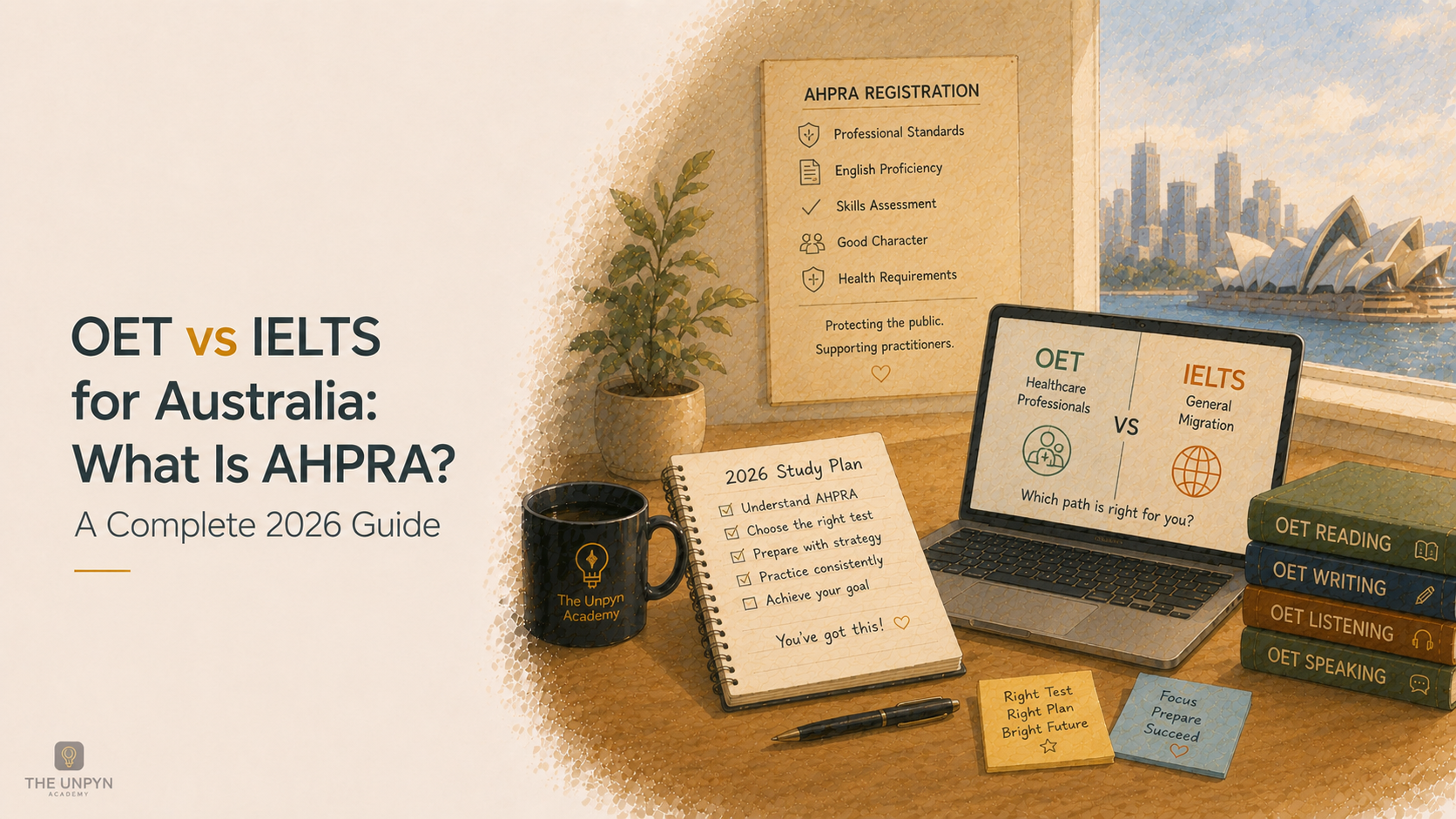
OET vs IELTS for AHPRA: Which Should You Choose?
This is the question most Indian healthcare professionals reach eventually — and it deserves a direct, profession-by-profession answer rather than a generic comparison.
The Core Difference
Both tests satisfy AHPRA's English requirement when minimum scores are met. The meaningful differences are in content, cost, visa compatibility, and where each test's demands align with your specific strengths.
| OET | IELTS Academic | |
|---|---|---|
| Content | Healthcare-specific in all four sub-tests | General academic in Reading and Writing; general conversational in Speaking |
| Writing task | Referral, discharge, or transfer letter based on clinical case notes | Task 1: describe a graph/chart; Task 2: academic essay |
| Speaking | Clinical role-play with a patient or carer | General conversation; Part 2 topic; Part 3 abstract discussion |
| Score validity for AHPRA | 2 years from test date | 2 years from test date |
| Fee (India approx.) | AUD 587 (~₹32,000–38,000) | ₹19,000 (standard); ₹19,250 (UKVI version) |
| Accepted for Australian skilled migration visa? | ✅ Yes — from August 2025, OET accepted for skilled migration | ✅ Yes |
| Accepted for UK Skilled Worker visa? | ✅ For healthcare professionals — verify for your SOC code | ✅ IELTS for UKVI |
| One Skill Retake available? | ❌ No | ✅ Yes (computer-delivered, within 60 days) |
Choose OET if…
You are a practising clinician with solid clinical English — you write referrals, discharge summaries, and patient correspondence regularly, and you feel natural in clinical communication contexts. OET Writing asks you to do something you already do at work. OET Speaking places you in consultations, education sessions, and clinical handovers — territory that is familiar.
The content advantage is genuine and significant for healthcare professionals who are already fluent in clinical English. Many find that OET, despite costing more, is achievable in fewer attempts — which can make the total cost lower than multiple IELTS sittings.
Choose IELTS Academic if…
You want one test to cover both AHPRA registration and your Australian skilled migration visa (the most common requirement for an 189 or 190 visa). IELTS Academic taken at a test centre satisfies both purposes.
You also want the security of the IELTS One Skill Retake — if you miss the threshold in one component, you can retake that component alone within 60 days rather than sitting the full test again. OET does not offer this option.
And IELTS is significantly cheaper, which matters if you may need more than one attempt.
The Fast-Track Calculation
For healthcare professionals trying to get to Australia as efficiently as possible:
- If you're targeting AHPRA registration only (not a visa simultaneously): OET can be the faster path if your clinical communication is strong — less preparation required for the Writing and Speaking content.
- If you're targeting AHPRA registration + skilled migration visa: IELTS Academic covers both. OET has been accepted for skilled migration since August 2025, so both are now valid — but IELTS is still more commonly used for visa purposes and better understood by migration agents.
- If you've already sat IELTS for your visa and need AHPRA compliance: check whether your existing IELTS Academic score meets AHPRA's current thresholds. If it does and it's still valid, you may not need another test.
What AHPRA Registration Involves Beyond the English Test
The English test is one requirement among several. Understanding the full picture prevents the common mistake of clearing the English test and then discovering months of other steps remain.
For doctors on the Standard Pathway, the full sequence typically involves:
- English language test — OET or IELTS Academic meeting AHPRA thresholds
- EPIC verification — primary source verification of your qualifications and identity through Education Commission for Foreign Medical Graduates
- AMC CAT — computer adaptive test of clinical knowledge across medicine
- AMC Clinical Examination — OSCE-style clinical skills assessment, OR an approved workplace-based assessment alternative
- Supervised practice — typically 12 months in an approved position
- General registration — issued by AHPRA on successful completion
The full timeline from starting the English test to holding general registration is typically 2–4 years for the Standard Pathway. The Competent Authority Pathway is faster — typically 6–18 months — but available only to doctors trained in recognised countries.
For nurses, the pathway is different: NMBA assessment of qualifications, English test, and in most cases a bridging programme or direct registration depending on the qualification assessment outcome.
For profession-specific and current pathway requirements, always verify directly with the relevant National Board on the AHPRA website (ahpra.gov.au).