The scepticism is understandable.
A one-hour, at-home, $70 test — accepted by the same universities as a three-hour, ₹19,000, test-centre exam? It sounds like a shortcut. And when something sounds too convenient, especially when a visa application or university admission is on the line, the natural instinct is to ask: is this actually legitimate, or will I get to the application stage and find out it wasn't enough?
The short answer in 2026: it's legitimate. The acceptance is real. But there are conditions, caveats, and country-specific limitations that matter — and the one mistake that costs students is treating "5,000+ universities accept Duolingo" as a blanket endorsement without checking whether it applies to their specific institution, programme, and destination country.
This blog gives you the full picture.
The Scale of Acceptance: Where Things Actually Stand in 2026
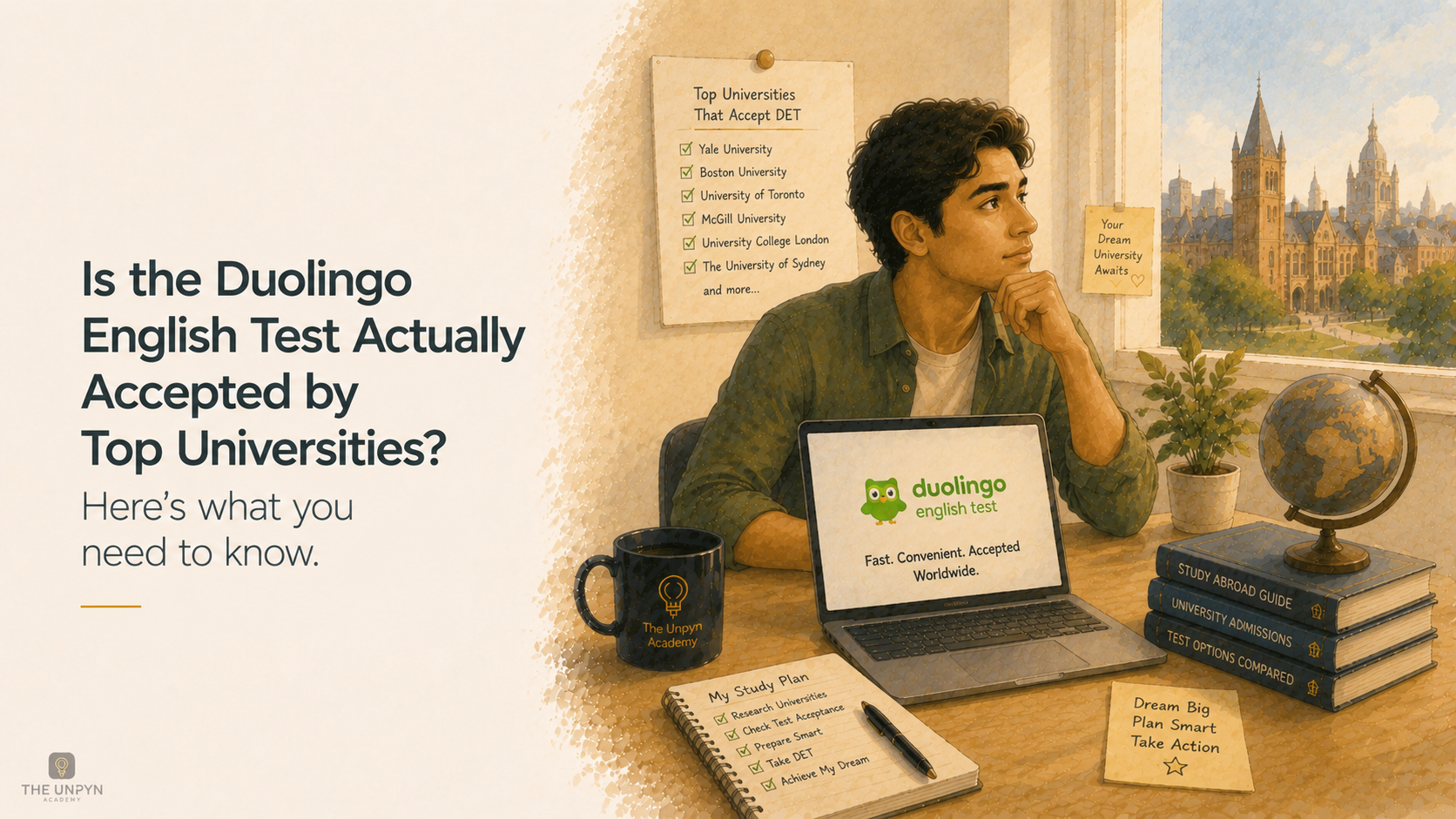
The Duolingo English Test is accepted by over 5,000 universities and programmes worldwide. In the United States — the single most DET-friendly destination — 95% of U.S. News Top 100 universities accept the DET for undergraduate admissions, including all Ivy League schools: Harvard, Yale, Princeton, Stanford, Columbia, Penn, Dartmouth, and Cornell.
Graduate schools are increasingly on board too, with close to 80% of America's top graduate programmes now accepting the test.
That's not a niche workaround. That's mainstream acceptance at the highest level of US higher education.
Beyond the US: Canada shows strong institutional acceptance, with approximately 90% of top Canadian universities by international student enrolment accepting DET for undergraduate study. In Ireland, 15 of the country's 18 universities accept the DET, and it is officially recognised for student visa applications.
The UK and Australia have broader institutional acceptance than most people realise — but with visa-level complications that need to be understood separately. More on that below.
Score Thresholds by Institution Type
Acceptance is one thing. Knowing what score you actually need is another. The DET scores on a scale of 10–160, and requirements vary significantly by institution selectivity and programme type.
United States — Score Requirements by Institution Tier
| Institution Type | Typical DET Minimum | Examples |
|---|---|---|
| Ivy League (undergraduate) | 120–135 | Columbia 135; Cornell, Penn 130; Yale 120–125 |
| Ivy League / elite (graduate) | 125–135 | Harvard select programmes 125+; NYU Stern 130+ |
| Top research universities | 115–125 | MIT (~120 in select depts); Stanford (~120 in select depts); Carnegie Mellon 120+ |
| Strong public universities | 105–115 | University of Michigan, UCLA, University of Washington |
| Mid-ranked universities | 95–110 | Purdue, Arizona State, many state universities |
| Community colleges / pathway programmes | 85–100 | Wide range |
Important note on Harvard and Stanford: Harvard requires an English proficiency test but does not publish required minimums. Stanford accepts DET in some departments. Always verify the current requirement for your specific programme on the institution's admissions page — policies vary by department and are updated without public notice.
Canada — Score Requirements
| Institution | Typical DET Minimum | Notes |
|---|---|---|
| University of Toronto | 120 | Verify per programme |
| University of British Columbia | 120 | Verify per programme |
| McGill University | 120 | Verify per programme |
| University of Waterloo | 115–120 | Verify per programme |
| Most mid-ranked Canadian universities | 105–115 |
UK — Score Requirements (Selected Institutions)
| Institution | Typical DET Minimum | Notes |
|---|---|---|
| Imperial College London | 120–125 | Verify per programme |
| University of Warwick | 110–120 | Verify per programme |
| University of Southampton | 110–115 | Verify per programme |
| University of Liverpool | 105–115 | Verify per programme |
| University of York | 105–115 | Verify per programme |
Disclaimer: All score thresholds are based on sources verified as of May 2026 and are subject to change without notice. University admissions policies update frequently. Always verify directly on the institution's official admissions page before registering for any test.
The Country-by-Country Reality
United States — The Most DET-Friendly Destination
The US is where DET works most cleanly. All Ivy League institutions list the Duolingo English Test among their accepted exams. The US government does not mandate a specific English test for the F-1 student visa — if your university accepts the DET for admission, it effectively covers your visa process too, since the I-20 form your university issues is what drives the visa application.
For students applying primarily to the US, DET is a direct, complete replacement for IELTS in most cases.
Canada — Strong Acceptance, Clear Visa Position
For a Canadian study permit, an English proficiency test is not listed as a required document in the study permit application — as long as you are admitted to a Canadian college or university, your English proficiency won't be an issue in the visa process.
In practice: if your Canadian institution accepts DET for admission, the DET covers you for the study permit too. You don't need a separate IELTS for the visa.
One important note: nearly half of Canada's top English-medium graduate schools accept the DET for Master's and PhD programmes — strong, but not universal. Graduate applicants in Canada should verify their specific programme's acceptance before booking.
United Kingdom — Admission Yes, Visa No
This is the most important caveat for students targeting the UK.
The Duolingo English Test is not accepted for UK visa applications. Some UK universities accept DET for admissions and may offer a conditional place, but you will still need a UKVI-approved test for the visa itself.
What this means practically: a UK university may accept your DET score and give you an offer. But to get your Student Visa from the UK Home Office, you will need a separate IELTS for UKVI or PTE Academic UKVI score. The DET gets you the offer; it doesn't get you the visa.
This is a significant planning and budget consideration for students targeting the UK. You are effectively looking at two tests, not one.
Australia — Growing Acceptance, Complex Visa Picture
Australian universities are increasingly accepting the DET, with top programmes at institutions like Flinders University and the University of Newcastle accepting it across all programmes, while others like Monash University accept it for foundation courses.
The visa position is more nuanced. The Australian government doesn't accept at-home tests for visa purposes — if you need to present proof of English proficiency for your visa, you'll need IELTS or another approved test centre exam. Whether you need to provide English proof for an Australian student visa depends on your passport country and the programme you're entering — check the Department of Home Affairs eligibility checker before making a decision.
Ireland — Clean and Simple
Ireland is notably DET-friendly. Fifteen of Ireland's 18 universities accept the DET, and it is officially recognised for student visa applications. For students targeting Ireland, DET is a straightforward choice with no separate visa test required.
Germany and Europe — Growing but Verify
Germany's English-taught programmes at institutions like TU Munich, RWTH Aachen, and Heidelberg increasingly accept DET. Acceptance across continental European universities varies significantly — some accept it universally, others only for specific programmes. The general direction is toward broader acceptance, but this is one region where individual programme verification is especially important.
The Country Comparison at a Glance
| Destination | University Acceptance | Visa Acceptance | Verdict |
|---|---|---|---|
| USA | ✅ Near-universal (95% of top 100) | ✅ DET covers visa if university accepts it | Best DET destination — no separate visa test needed |
| Canada | ✅ Strong (~90% of top universities) | ✅ Study permit doesn't require specific English test | Strong choice — DET covers admission and permit |
| Ireland | ✅ 15 of 18 universities | ✅ Accepted for student visa | Clean, simple — no complications |
| UK | ✅ Many universities (growing) | ❌ Not accepted by UK Home Office (UKVI) | Two tests needed: DET for admission + IELTS for visa |
| Australia | ✅ Growing (varies by institution) | ⚠️ Depends on passport and programme | Check DIBP eligibility; may need IELTS for visa |
| Germany / Europe | ✅ Growing for English programmes | Varies by country | Verify per institution |
The Questions You Need to Ask Before Booking
The single most expensive DET mistake is booking the test before verifying that it works for your specific situation. Here are the four questions to answer first:
Does my specific programme at my specific institution accept DET? Not "does the university accept DET" — does your programme accept it. Business schools within the same university sometimes have different requirements from STEM departments. Check the programme page, not the university homepage.
Does DET also satisfy the visa requirement for my destination country? USA and Canada: yes in most cases. UK: no. Australia: depends on your passport. Confirm before assuming.
What is the minimum DET score for my programme? Acceptance without knowing the minimum score is useless information. Find the specific number required for your target programme and build your preparation around it.
Has the policy changed recently? DET acceptance policies update more frequently than IELTS or PTE requirements. A programme that accepted DET in 2024 may have changed its policy for 2026 intake. Always check the current admissions page, not a third-party list.
What the "5,000+ Universities" Claim Actually Means
It's accurate. But it includes every institution that accepts DET across all countries and programme types — from Ivy League graduate schools to community colleges, from the US to Germany to Singapore.
The meaningful question is not whether 5,000+ institutions accept it. It's whether the specific institution, programme, and country combination on your list does.
For the United States, approximately 95% of top-ranked universities and 75% of graduate programmes with high international enrolment accept DET — including MIT, Harvard, Stanford, and Yale. That's a genuine signal of credibility. For UK visa applications, that signal doesn't help you.
The test is legitimate. The acceptance is real. The conditions are what you need to understand before it becomes your choice.