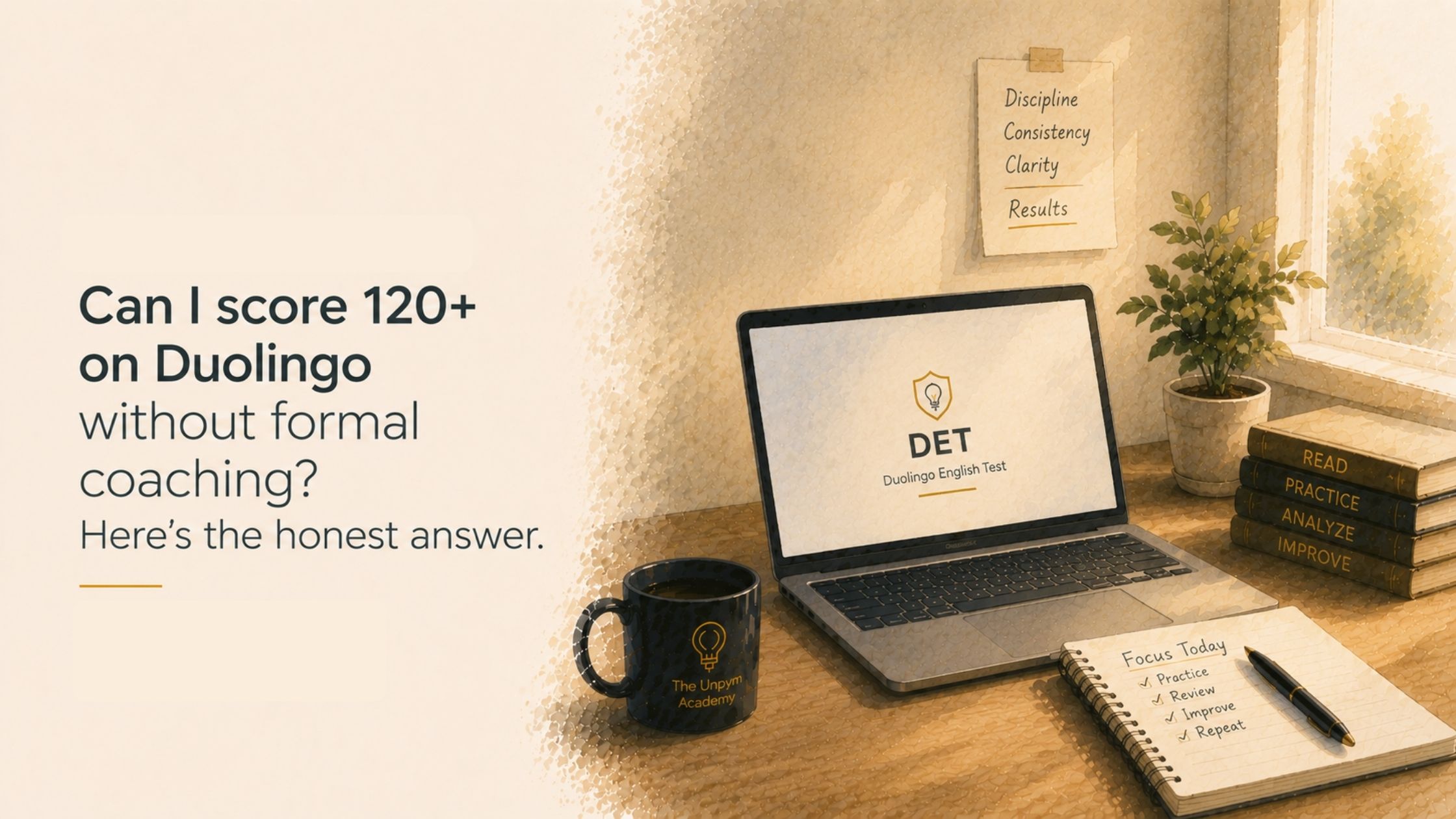
Yes. You can.
But whether you specifically can, right now, with your current English level, in the timeline you're working with, depends on a few things that generic YouTube videos and prep blogs will never be straight with you about. Because they want your attention, not your result. We'd rather just tell you the truth.
First, Let's Put 120 in Context
The Duolingo English Test scores on a scale of 10 to 160. Your overall score is the average of four individual subscores: Reading, Writing, Listening, and Speaking, each also reported out of 160.
A score of 120 is roughly equivalent to IELTS 6.5 and TOEFL 87–92. It's sufficient for most undergraduate and postgraduate programmes that accept the DET. The average score of all test takers in 2024–2025 was 110. So 120 puts you in the upper half — above average, but not at the sharp competitive end.
For context: 25% of all DET test takers score above 125. If your target university wants 120, you're aiming to land in the top 40–50% of everyone who takes this test globally. That's not easy. It's also not out of reach — provided you understand what the test is actually measuring, and where most people lose their score.
What the Test Is Actually Measuring (And Why It Matters for Self-Prep)
This is the part most prep guides skip over, and it's the most important part.
The DET is adaptive. That means the questions don't follow a fixed difficulty — they adjust in real time based on how you're doing. Get something right, the next question gets harder. Struggle, and it eases off. This means cramming a list of vocabulary or memorising a template won't get you to 120. The test keeps going until it finds your actual level.
What the test is really measuring is whether you can use English fluently under timed, unscripted pressure. Not whether you know the rules. Not whether you can produce perfect grammar when you have time. Whether you can activate your English quickly and accurately when the clock is running.
There are four subscores:
Literacy — Reading + Writing. Academic reading comprehension and written response quality.
Comprehension — Listening + Reading. How well you process spoken and written English in real time.
Conversation — Speaking + Listening. Natural, back-and-forth spoken exchange.
Production — Speaking + Writing. Fluency in generating language on demand, under pressure.
Universities receive all four subscores alongside your overall. A high overall with a low Production score tells an admissions office that you can understand English but struggle to produce it — which is precisely the skill they need you to have in lectures, seminars, and written work.
And here's the thing about self-prep: most people plateau at their Production score.
The Self-Prep Ceiling — and Where It Actually Sits
For most people — working professionals, students with solid conversational English, anyone who reads and writes in English regularly — self-preparation is enough to reach somewhere between 100 and 115. With good resources, consistent practice, and a few full-length mock tests, that range is genuinely achievable through self-study.
That's actually sufficient for a large number of programmes. Many undergraduate admissions accept 105–115. If that's your target and your English is already at that level functionally, you may not need coaching at all.
But 120 and above is a different story. Here's why.
The Production Problem
Most students who plateau at 105–115 have the same issue: low Production subscore. They can read, they can listen, they can understand — but when they need to speak or write on demand, under time pressure, something breaks down.
It's almost never a vocabulary problem. The words are there. The grammar is known. What's missing is retrieval speed — the ability to access the right language instantly, without the half-second lag where the brain switches from thinking to expressing.
This lag is invisible in daily conversation, where pace is natural and no one is scoring you. It's visible and scoreable on the DET, where Speaking prompts give you 60–90 seconds and the AI is assessing fluency, coherence, and whether your response fully addresses the prompt.
Self-prep can help you learn what the question types look like. It cannot easily replicate the conditions under which your production breaks down — because when you're practising alone, you control the pace, you can restart, and there's no real consequence for hesitating.
The Picture Description Trap
One of the highest-leverage question types on the DET is image description. You'll encounter it in both Writing (three written responses) and Speaking (one spoken response). That's four questions in a 60-minute test — a significant share of your Production subscore.
Here's what makes it hard: most people have almost no practice describing images in everyday life. Even native English speakers find it unnatural at first. The students who do well on image description have a template — a structured approach that tells them what to describe, in what order, using what vocabulary. That template isn't innate. It has to be learned, practised, and internalised until it's automatic. Learning it from a blog post and practising it alone, with no feedback on whether your response was complete or your language was specific enough, is where self-prep runs into its limits.
The Advanced Vocabulary Trap
To score 120 and above, using advanced vocabulary is necessary. Basic, accurate writing isn't enough — the AI scoring your Writing responses is assessing lexical range, not just correctness.
But here's the trap: using advanced vocabulary incorrectly costs points. It doesn't just fail to gain you marks, it actively lowers your score. A precisely used common word scores better than an incorrectly used advanced one.
Most self-preppers learn advanced vocabulary in lists. They then use it in contexts they're not fully confident about, and the AI — which is trained on thousands of human-scored responses — flags the misuse. Getting this right requires feedback, not just a word list.
What High Scorers Actually Have in Common
People who consistently score 120+ on the DET share a few patterns. None of them are about intelligence, and all of them are trainable.
They speak English every day, not just during study sessions. The DET measures activation under pressure. That activation improves through daily use, not weekly practice.
Their Speaking is structured, not spontaneous. 120+ Speaking responses follow a pattern: clear opening, developed middle, clean conclusion — even in a 60-second prompt. High scorers have practised structuring responses until the structure is automatic.
They know the question types cold. The DET has a specific set of task types. High scorers don't encounter these tasks for the first time on test day. They've practised each one enough to have a default approach.
They don't have uneven subscores. A 130 in Literacy with a 105 in Production gives an overall around 115–120, but flags to universities that output skills are weaker than comprehension. High scorers have worked on the skill pulling them down — usually Production — until the profile is balanced.
Hitting a plateau around 108–112 and can't figure out why? We look at your subscores and build a plan around exactly what's pulling you down.
Talk to a TrainerSo: Can You Self-Prep to 120+?
Here's the honest matrix.
You probably can self-prep to 120+ if:
Your conversational English is already strong and naturally fluent
You're a confident, frequent writer and speaker of English in your daily work or life
You need 115–120 (not 125+) and have 6–8 weeks to prepare seriously
You're willing to take multiple full-length practice tests, review every response, and actively work on Production with recorded self-assessment
Your baseline practice test is already coming in around 105–110
Coaching will likely make a decisive difference if:
Your baseline is below 100 and you need 120+
You're hitting a plateau — taking tests, practising, and not moving past 108–112
Your Production or Conversation subscores are significantly lower than your Literacy or Comprehension
You have 3–4 weeks, not 6–8, because your timeline is tight
You've taken the test once and the score wasn't what you expected, but you're not sure exactly what went wrong
The honest truth about formal coaching isn't that it teaches you English you don't have. It identifies precisely where your score is being lost, gives you feedback on the production and speaking tasks you can't accurately self-assess, and compresses the timeline between "I kind of know what to work on" and "I am consistently hitting my target in practice." That's what coaching actually changes. Not the ceiling — your English determines the ceiling. The speed at which you reach it.
What a Good Self-Prep Plan Actually Looks Like
If you're going to self-prep seriously, here's the structure that gives you the best chance:
Week 1 — Baseline and Diagnosis: Take a full official practice test. Note your overall score and all subscores. The Production subscore is your first priority if it's below your target. Identify the two or three question types where you lost the most ground.
Weeks 2–4 — Question-Type Mastery: Work through each question type systematically, not randomly. Image description first — it has the highest impact on Production and it's the most learnable with a template. Interactive Writing and Speaking next. Time every practice response. Review it. Record your Speaking. Listen back to it. Be honest about where fluency breaks down.
Vocabulary — Build Academically, Not Randomly: Group vocabulary by theme: academic processes, cause and effect, comparison and contrast, describing data, describing images. Learn words in sentences, not lists. Before using an advanced word in a test response, make sure you've used it correctly in at least five practice sentences.
Final 2 Weeks — Mock Test Under Real Conditions: Take at least two full-length mock tests in your actual testing environment — door closed, secondary camera set up, no interruptions. Review your subscores after each one. If Production is still lagging, this is the signal to get feedback from someone who can tell you specifically what the AI is flagging.