This is an uncomfortable question, and it deserves an honest answer.
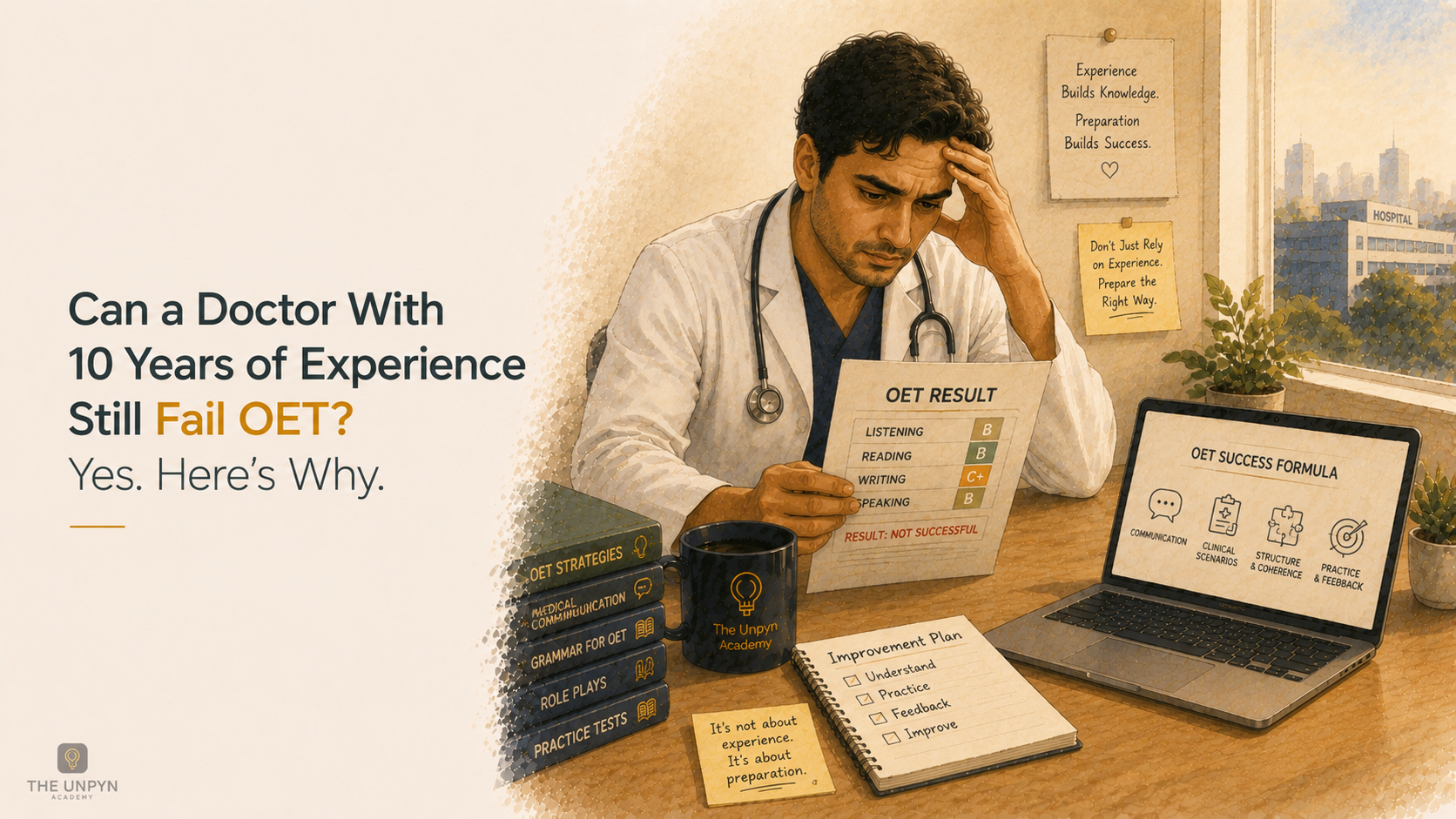
Yes. A doctor with a decade of clinical experience — someone who has diagnosed, treated, documented, and communicated medicine every day for ten years — can, and regularly does, fail OET. Sometimes more than once.
It's not a reflection of clinical competence. It's not a reflection of intelligence. It happens because OET is not testing whether you are a good doctor. It is testing whether you can demonstrate a specific set of English communication behaviours — in writing and in speaking — that the exam defines and scores against fixed criteria. And clinical experience, however extensive, does not automatically develop those behaviours.
Understanding why this happens is the first step to making sure it doesn't happen to you.
Why Experience Creates Blind Spots
Experienced doctors carry something into the OET that junior doctors don't: deeply ingrained clinical communication habits. These habits were built over years of real practice, reinforced by feedback from patients and colleagues, and optimised for clinical environments.
The problem is that clinical communication optimised for a ward or outpatient setting is not the same as communication that scores well in OET. In some specific ways, the habits of an experienced clinician actively work against the behaviours the OET rewards.
Three patterns appear most consistently.
The First Pattern: Clinical Efficiency vs. Patient-Centred Communication
In clinical practice, experienced doctors are efficient. They've learned to triage information, cut to what matters, move the consultation forward. Time is limited. Decisions need to be made.
In OET Speaking, this efficiency reads as dismissiveness.
The OET Speaking role-play is assessing nine criteria, five of which are Clinical Communication criteria: Relationship Building, Understanding and Incorporating the Patient's Perspective, Providing Structure, Information Gathering, and Information Giving. Of these, Relationship Building and Understanding the Patient's Perspective are where experienced doctors most commonly lose marks.
The scenario plays out like this: the doctor receives a role-play card describing a patient who is anxious about a diagnosis. The experienced doctor addresses the clinical facts accurately, covers the management plan clearly, and wraps up within the time. What they often don't do — because it doesn't feel necessary — is pause on the patient's emotional state. Acknowledge it explicitly. Name it. Ask about it.
In clinical practice, a patient who seems anxious often gets reassured incidentally — through tone, through body language, through the familiarity of a therapeutic relationship built over multiple visits. In a five-minute role-play with a stranger acting as a patient, none of that context exists. The examiner needs to see the acknowledgement happen in words, because words are all they have.
An experienced doctor who has learned to communicate empathy implicitly may score poorly on criteria that require it to be expressed explicitly.
What it looks like in practice:
The patient says: "I'm really scared about what this means for my children."
The experienced doctor responds: "That's understandable. So the first thing we need to do is organise a specialist referral..."
The OET-aware response: "I can hear how worried you are, and that concern for your children makes complete sense. I want to make sure we address that properly. Can you tell me a bit more about what's worrying you most, so I can help you understand what this actually means for your family?"
Both responses come from competent doctors. Only one scores on Understanding the Patient's Perspective and Relationship Building.
The Second Pattern: Ward Register vs. Patient Register
Experienced doctors are comfortable with two registers of clinical communication: the formal clinical register used with colleagues (ward rounds, referral letters, handover) and the informal register of patient consultations. Both are natural and well-practised.
OET Writing tests a third register that many doctors use less consciously — the formal, professional letter written to a colleague about a patient. And OET Speaking tests the specific register of patient education and counselling in plain English.
In Writing, the most common error pattern for experienced doctors is carrying clinical shorthand into a formal letter. Case notes use abbreviations, incomplete sentences, implied subjects, and shorthand that colleagues understand instantly. The OET discharge letter or referral is assessed on whether it communicates clearly to the reader — which means complete sentences, formal tone, and clinical information translated into the level of specificity and structure that a receiving clinician needs.
A doctor who has written thousands of clinical notes may write an OET letter that is accurate in content but informal in register — full of the contracted, telegraphic style of ward documentation rather than the formal, considered structure of a professional letter. This affects the Genre and Style criterion directly.
In Speaking, the specific risk for experienced doctors is using technical language with patients that assumes more background knowledge than the role-play patient has. It's a habit built in specialist practice where patients often have some familiarity with their condition. In OET, the patient character is typically a general member of the public encountering medical information for the first time.
Using clinical terminology without explanation — referring to a patient's "left ventricular dysfunction" rather than "a weakening of the main pumping chamber of the heart" — fails the Appropriateness of Language criterion, regardless of how accurate it is.
The Third Pattern: The Discharge Summary Trap
OET Writing for doctors most commonly involves a discharge letter or referral letter based on clinical case notes. This is territory experienced doctors feel entirely at home in — they write discharge summaries regularly.
And yet the OET discharge letter specifically exposes a pattern that experienced doctors share: including information that is true and clinically relevant but not useful to the recipient.
The most frequent writing mistakes in OET discharge letters include overloading with irrelevant details, word-for-word copying of case notes, unsound or illogical organisation, and inconsistent use of formal register and tone.
In clinical practice, the instinct is to include everything — because incomplete information can be dangerous. In OET Writing, the letter is assessed on Conciseness and Clarity: whether you have selected the information that the recipient needs, excluded what they don't, and organised it logically for their specific purpose.
An OET discharge letter addressed to a GP following a patient's cardiac admission does not need the full history of the patient's unrelated diabetes management. It needs the reason for admission, the treatment given, the discharge condition, the medications, and the follow-up instructions. Everything else is noise — and including it reduces the Clarity and Conciseness score, while copying it word-for-word from the case notes reduces the Language score.
Experienced doctors who are used to comprehensive discharge documentation often write OET letters that are too long, too dense, and too unfiltered — because the clinical habit is thoroughness, and the OET criterion is selectivity.
The Specific Discharge Letter Mistakes — at a Glance
| Mistake | What It Costs | What to Do Instead |
|---|---|---|
| Copying case notes verbatim | Language criterion — paraphrasing expected | Summarise and synthesise in your own words |
| Including all history regardless of relevance | Conciseness and Clarity | Select only what the recipient needs for this specific handover |
| Clinical abbreviations without expansion | Appropriateness and Clarity | Write in full where the recipient may not share the same shorthand |
| Opening without a clear statement of purpose | Purpose criterion | First sentence must state why you are writing and about whom |
| Passive voice throughout | Organisation and style | Active, direct sentences communicate more clearly |
| Inconsistent tense | Language criterion | Past tense for history and treatment; present for current status |
| Missing follow-up or ongoing management | Content criterion | Always close with what needs to happen next and who is responsible |
What OET Is Actually Testing
Here is the clearest way to understand why experience doesn't guarantee success: OET is not testing whether you can practise medicine. AHPRA will assess that separately through examinations, supervised practice, and specialist college assessment.
OET is testing whether you can communicate your clinical practice in English — specifically in the registers and formats that English-speaking healthcare systems use. These are learnable. They are not acquired automatically through clinical experience, even years of it.
The doctor with ten years of experience has an enormous advantage in OET in one sense: the clinical content of every role-play and every case note is familiar territory. They will never struggle to understand what's happening clinically, what the patient needs, or what the letter should communicate. That advantage is real.
The gap is in the specific communication framework the OET rewards — and that framework needs to be learned deliberately, not assumed.
What Preparation Looks Like for an Experienced Doctor
The preparation that works for experienced doctors is not the same as the preparation that works for junior doctors or nurses.
Junior doctors and nurses often need to build clinical context — understanding what the scenarios mean clinically. Experienced doctors don't. They need to recalibrate their communication to the OET framework specifically.
For Writing: one or two sessions diagnosing exactly which criteria your letters are losing marks on, followed by focused practice on those criteria. If Conciseness is the gap, practise selecting rather than including. If Register is the gap, practise the formal letter tone. If Purpose is the gap, practise opening sentences that state reason, patient, and context in one clear statement.
For Speaking: recorded mock role-plays with feedback mapped to the nine criteria. Specifically looking for moments where clinical efficiency overrides patient-centred communication, where jargon replaces plain English, and where the patient's emotional state is moved past rather than acknowledged.
The turnaround for experienced doctors who get the right feedback is typically fast — faster than for less experienced candidates — precisely because the clinical knowledge is already there. The gap is specific and fixable.