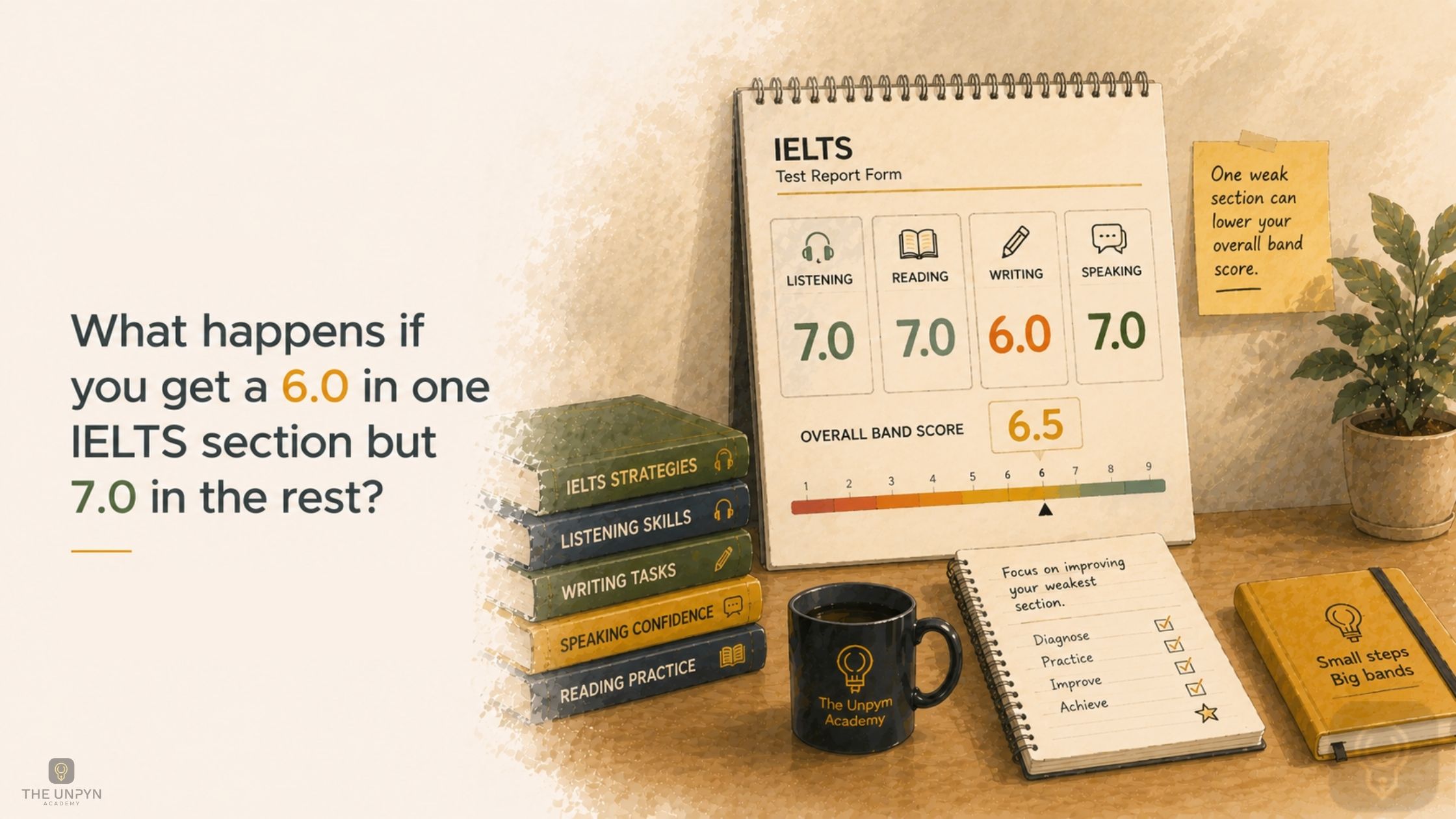
IELTS Listening is the section most people feel quietly confident about going in. It's English. You listen. You write down what you hear.
Then the results come back and Listening is somehow lower than expected — lower than Reading, lower than the score you were scoring in practice. And the question that follows is a version of the same one every candidate asks: what went wrong?
Almost always, the answer is technique, not English ability. The IELTS Listening test is specifically designed to reward focused attention, strategic reading of questions, and the ability to avoid traps that sound like answers but aren't. None of those skills develop automatically from general English practice. They're learned.
Here's the full picture — mistakes at a glance first, then in detail.
Mistakes at a Glance
#MistakeWhat It CostsFix
| # | Mistake | What It Costs | Fix |
|---|---|---|---|
| 1 | Writing the first answer you hear | Wrong answer chosen — the distractor, not the final answer | Wait for the speaker to finish the thought; listen for corrections |
| 2 | Not reading questions before the audio starts | No prediction; missed context; wrong focus while listening | Use every second of preparation time to read ahead |
| 3 | Losing all marks after missing one answer | Cascade of missed answers through panic | Guess and immediately move forward — never look back |
| 4 | Ignoring the word limit | Correct answer marked wrong due to extra words | Read the instruction: "ONE word," "NO MORE THAN TWO," etc. |
| 5 | Spelling errors on gap-fill answers | Correct answer marked wrong | Practise spelling common IELTS vocabulary; spell-check during transfer |
| 6 | Writing what you expect instead of what you hear | Plausible-sounding wrong answer | Follow the audio strictly; don't "fill in" from logic |
| 7 | Unfamiliar accents causing comprehension failure | Missed answers in sections with non-British speakers | Deliberately expose yourself to Australian, American, Canadian, NZ accents |
| 8 | Misreading question type and answering wrong format | Correct information, wrong format — zero marks | Read question type before every section |
| 9 | Missing Section 4 — the hardest section | Disproportionate mark loss in the final ten questions | Practise Section 4 specifically; it is academic monologue, not conversation |
| 10 | Not transferring answers cleanly to the answer sheet | Errors introduced during transfer, not during listening | Use transfer time carefully; check every answer once |
Mistake 1: Writing the First Answer You Hear
This is the most deliberately engineered mistake in the IELTS Listening test. Examiners insert distractors — pieces of information that sound like the answer, appear at the right moment, and fit the question — specifically to reward candidates who listen to the end of the speaker's thought rather than the first plausible detail.
The pattern appears constantly, most visibly in Section 1. A speaker says: "The meeting is at 3pm... actually, let me check — yes, 4:30." If you wrote 3pm, you fell for the distractor. The answer is 4:30.
Self-corrections are one of the most frequent IELTS listening traps. A speaker gives a detail, then corrects it. The first detail is the distractor; the corrected detail is the answer. This pattern applies to times, prices, dates, locations, and names — the most common gap-fill answer types.
How to fix it: Train yourself to wait until the speaker finishes a complete thought before committing to an answer. When you hear a number, name, or location, hold it mentally rather than writing it immediately. If the speaker continues talking, they may correct or revise it. The answer is always the speaker's final confirmed information, not the first piece they mentioned.
A practical drill: take a practice recording and specifically track every time a speaker changes their mind, corrects themselves, or introduces a "but" or "actually." That habit of tracking speaker direction, rather than just catching facts, is what separates Band 7 Listening from Band 6.
Mistake 2: Not Reading Questions Before the Audio Starts
Every section of the IELTS Listening test provides a preparation window before the audio begins. Most candidates glance at the questions. The ones who score highest treat those 30–60 seconds as the most important preparation they do in the entire section.
Prediction is one of the most powerful skills in IELTS Listening. Before the audio begins, quickly analyse the questions to understand what type of information is required.
Reading ahead does several things simultaneously: it tells you what kind of answer to expect (a name, a number, a location, a reason), it primes your brain to filter out irrelevant information, and it tells you approximately when each answer will come — so you're never caught off-guard by the sequence.
How to fix it: In practice, time yourself during the pre-listening window. Every gap should be scanned before the audio starts. Ask yourself for each gap: is this a number? A noun? A name? A place? Underline key words in the question that will help you locate the answer moment in the audio. When the audio plays, you're confirming a predicted answer type — not starting from scratch.
Mistake 3: Losing Everything After Missing One Answer
The cascade mistake. A candidate misses answer 7. Instead of moving on, they stay mentally on answer 7, trying to reconstruct what they missed — and while doing so, they miss answers 8 and 9 as well. One missed answer becomes three.
Once you miss a question, continuing to focus on it is pure loss. The audio does not wait, and the next answers are moving away from you at the same pace regardless of whether you heard question 7.
How to fix it: The correct response to a missed answer is an immediate, deliberate move forward. Write a reasonable guess — any plausible word that fits the gap grammatically — and shift your full attention to the next question before the audio covers it.
This sounds simple. It requires deliberate practice to execute under pressure. In every practice session, actively rehearse the mental discipline of abandoning a missed answer completely. Candidates who can do this lose one mark instead of three, four, or five.
Mistake 4: Ignoring the Word Limit
Every IELTS Listening gap-fill instruction specifies a word limit: "ONE WORD ONLY," "ONE WORD AND/OR A NUMBER," "NO MORE THAN TWO WORDS." Exceeding this limit results in an incorrect answer — even if the information itself is right.
This catches people in two specific ways. First, candidates add articles ("the laboratory" when the limit is one word — "laboratory" is correct, "the laboratory" is not). Second, candidates write the full phrase they hear when only part of it is required.
How to fix it: Read the instruction word limit before every gap-fill section — not once at the start of the test, every time you encounter a new set of questions. During practice, make a specific habit of checking your answers against the word limit before you commit them. If your answer contains more words than permitted, identify which word carries the essential meaning and strip the rest.
Mistake 5: Spelling Errors
IELTS Listening is marked on accuracy. An incorrectly spelled word is a wrong answer, regardless of how close it is to the correct spelling. Common errors include doubled consonants (accommodation, occurrence), homophones (there/their, whether/weather), and words that sound different from how they're spelled (Wednesday, February, February).
How to fix it: Build a list of commonly tested IELTS Listening vocabulary and practise spelling it. Focus on proper nouns (street names, place names), academic vocabulary, and words with common spelling pitfalls. During the answer transfer period at the end of the test, do a single focused check on spelling — particularly on any word you felt uncertain about while writing.
The IELTS Listening test uses British, Australian, American, and New Zealand accents. This matters for spelling too: the letter 'Z' is pronounced "zed" in British English and "zee" in American English. Numbers, letters of the alphabet, and proper nouns are particularly prone to mishearing across accents.
Mistake 6: Writing What You Expect Instead of What You Hear
This mistake is especially common for candidates who read the questions carefully before the audio — which is the right strategy — but then allow the context they've built up to override what they actually hear.
If the question context suggests a medical setting and the gap seems to need a symptom or diagnosis, candidates sometimes write a plausible medical term they predict — rather than the specific word the speaker used. The prediction was close. The answer was different.
How to fix it: Prediction prepares you to listen for a type of information. It does not authorise you to fill in the answer yourself. Your job is to track what the speaker actually says and confirm or update your prediction in real time. If what you hear doesn't match what you predicted, follow the audio — it is always right.
Mistake 7: Unfamiliar Accents
The IELTS Listening test deliberately uses speakers with British, Australian, New Zealand, American, and Canadian accents. Section 1 and Section 2 are typically British or Australian. Sections 3 and 4 can feature any accent combination.
For Indian test-takers who have primarily been exposed to Indian or American English, Australian vowel sounds and New Zealand accent patterns can cause a specific kind of confusion — not comprehension failure overall, but moment-to-moment mishearing of specific vowels and word endings that affects gap-fill accuracy.
How to fix it: Accent exposure is the only fix, and it needs to start early in preparation. BBC Radio 4 and BBC World Service for British English, ABC Radio Australia for Australian English, Radio New Zealand for New Zealand English. Thirty minutes of daily passive listening — during a commute, while cooking — across all accent types builds the ear quickly. The IELTS Cambridge practice books (Series 9–18) also use authentic multi-accent recordings and are the closest simulation available.
Mistake 8: Misreading the Question Type
IELTS Listening contains multiple question types: gap-fill, multiple choice, map labelling, matching, sentence completion, and short answer. Each type has a different correct format for the answer.
A candidate who hears the right information but writes it in the wrong format — a full sentence when a single word is required, or multiple choices when only one is permitted — scores zero for that question.
How to fix it: Before each new section of questions, specifically identify the question type and re-read the instruction. This takes five seconds and prevents a category of error that has nothing to do with your English or your listening ability. In practice tests, deliberately note what type of question each section uses before you start.
Mistake 9: Underestimating Section 4
Section 4 is consistently the hardest section in the IELTS Listening test and the one where marks are most frequently lost. It is an academic monologue — one speaker, no conversation, no Section 1-style friendly exchange — typically on an academic or scientific topic. It runs for approximately ten questions without a break.
Many candidates do not specifically prepare for Section 4. They practise general Listening and assume Section 4 will follow. It is harder than the other sections because there is no conversational rhythm to anchor the content, academic vocabulary increases in density, and the pace doesn't drop.
How to fix it: Practise Section 4 specifically and repeatedly. Use Cambridge Series practice tests and time only Section 4 multiple times until you are comfortable with the academic monologue format and density. Specifically practise listening for signalling language — "the most important point is," "this leads to," "in contrast" — which is how academic speakers organise and flag information without conversational cues.
Mistake 10: Sloppy Answer Transfer
At the end of the IELTS Listening test, candidates have 10 minutes (paper-based) or 2 minutes (computer-delivered) to transfer answers from their question paper to their answer sheet. For most people this feels like a formality — and it's where entirely avoidable errors get introduced.
Handwriting becomes illegible under time pressure. Answers are copied into the wrong numbered box. Spelling is rushed. A word read correctly during the listening is transferred with a typo.
How to fix it: Use the transfer period with the same care as the listening itself. Write clearly. Transfer in order. Check each answer once after writing — specifically for spelling and word limit. The answer sheet is what gets marked, not your question paper.
The Pattern Behind the Mistakes
Reading this list, you'll notice that none of these mistakes are about English ability. They are about attention control, technique, and deliberate strategy under timed, pressure conditions.
Distractors are deliberately inserted to test attention control rather than vocabulary size. The exam is designed this way. The candidates who score highest in Listening are not those with the strongest English — they're those who have learned, through practice and reflection, to track speaker intent rather than just catch words.
Every mistake above is fixable. Most of them become automatic corrections within two to three weeks of deliberate, review-focused practice — not just running through test after test, but stopping after each practice section to identify exactly which mistake caused each wrong answer, and drilling the correction.