Three attempts. Three 6.5s. Thousands of rupees in exam fees. Weeks of preparation each time. And the same number, every time, staring back at you.
You've done the practice tests. You've watched the YouTube videos. You've bought the Cambridge books. You know the format. And you still can't get to 7.0. Here's the difficult truth: if you've taken the test three times and arrived at 6.5 each time, doing more of what you've already done will not get you to 7.0. The approach needs to change, not just the effort.
This is a diagnosis. Not a pep talk, not a list of generic tips. Let's figure out what's actually keeping you at 6.5.
First: Understand What 6.5 Is Actually Telling You
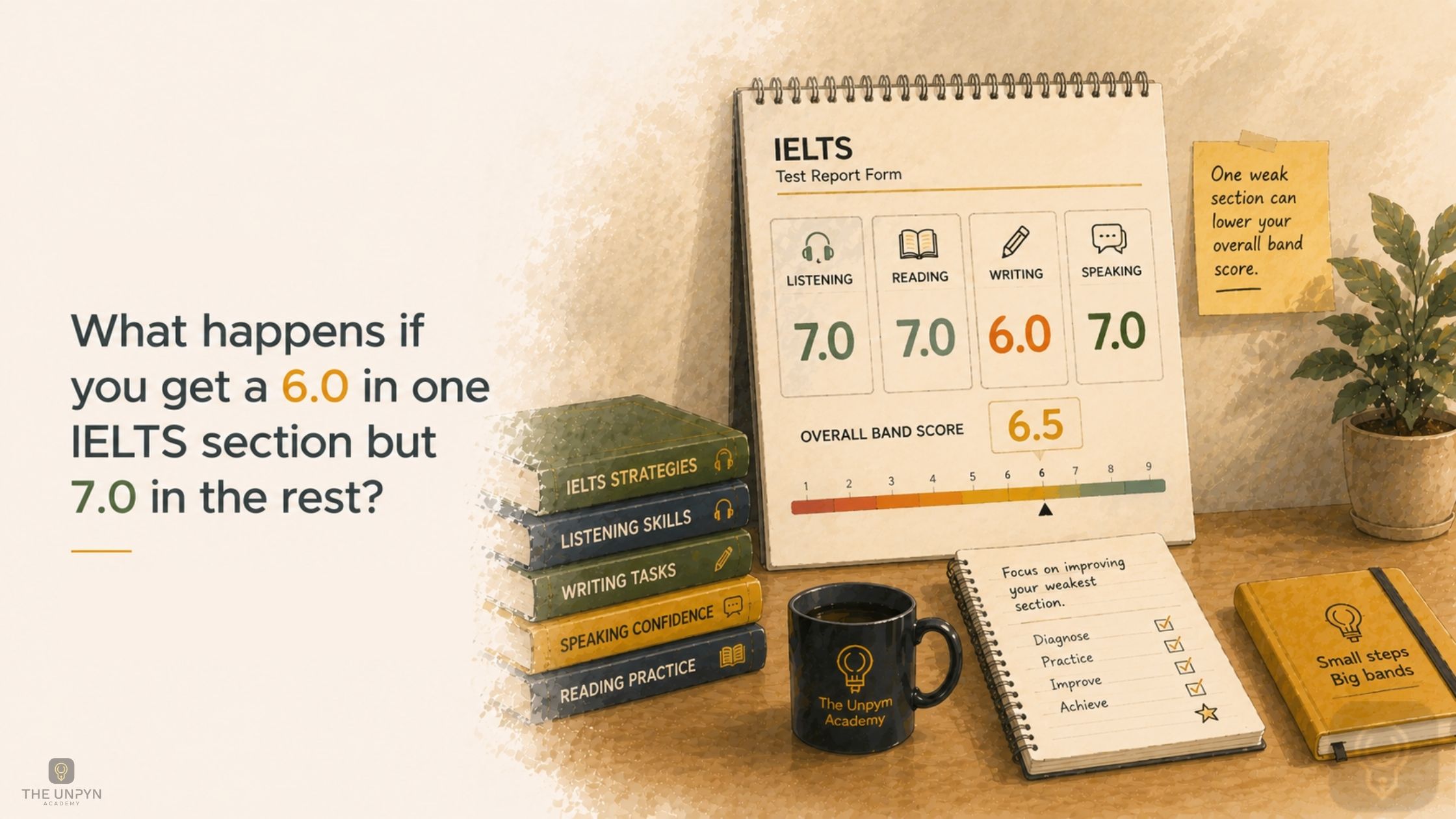
A 6.5 overall score is the average of four individual band scores — Listening, Reading, Writing, and Speaking. Before you can fix anything, you need to know which of those four scores is pulling your average down.
The most common profile for people stuck at 6.5 looks like this:
L: 7.0 / R: 7.0 / W: 6.0 / S: 6.5 → Overall: 6.5
Strong Listening and Reading, weaker Writing and Speaking. This pattern is so common it has a name: the passive-active gap. Your receptive English is strong. Your productive English — generating written and spoken language under timed conditions — is where you're losing marks. The good news: productive skills are trainable. Look at your TRF (Test Report Form) from your most recent attempt. Your four individual scores will tell you more than anything else in this post.
The Four Profiles — Which One Are You?
Profile 1 — The Consistent 6.5
Typical scores: L: 6.5 / R: 6.5 / W: 6.5 / S: 6.5. Evenly developed at Band 6 across all four skills. The issue isn't a specific skill gap — your overall English level is solid B2 but hasn't crossed into C1. This profile needs the broadest work and the longest timeline: 3–6 months of genuine English-level improvement, not just test practice.
Profile 2 — Strong Receptive, Weak Productive
Typical scores: L: 7.5 / R: 7.0 / W: 6.0 / S: 6.5. The most common profile. Your passive vocabulary is larger than your active vocabulary. Targeted work on Writing and Speaking production — not general English — is the fix.
Profile 3 — Writing Is the Specific Blocker
Typical scores: L: 7.5 / R: 7.0 / W: 6.0 / S: 7.0. Everything is where it needs to be, except Writing. This is extremely common and deeply frustrating because one section is costing you the overall band. Writing sub-skills at this level are diagnosable — see below.
Profile 4 — All Scores Just Under 7.0
Typical scores: L: 6.5 / R: 7.0 / W: 6.5 / S: 6.5. Tantalisingly close everywhere. Often a single well-targeted intervention — in Coherence, Lexical Resource, or Grammatical Accuracy — is enough to pull multiple scores over the line simultaneously.
Why Writing Keeps You at 6.5
The most common belief at 6.5: "I need more complex vocabulary and grammar to reach 7.0."
The truth: "You need more accurate vocabulary and grammar. The complexity you already have is often working against you."
The Band 7 descriptor says: frequently produces error-free sentences. Not all sentences. Not zero errors. But frequent error-free sentences. If your writing produces errors in most sentences — even small ones like missing articles, inconsistent tenses, or comma splices — you are not meeting the Band 7 criterion for Grammatical Range and Accuracy.
The Four Things Keeping Your Writing at 6.5
Inconsistent article use (a/an/the). For speakers of Indian languages, this is the single most common grammar error in IELTS Writing — and one of the most costly. Articles appear in almost every sentence. A pattern of article errors means a pattern of errors across the entire essay. This is one of the highest-return fixes available.
Task 2 position shifting mid-essay. At Band 6, candidates often answer the prompt but lose consistency. Does your conclusion match your introduction? Does every body paragraph serve the position you stated at the start? If any paragraph is a detour, it's costing you Task Achievement marks.
Mechanical cohesive devices. "Firstly… Secondly… Furthermore… In conclusion…" Starting every sentence with a transition signal is a reliable marker of a Band 6 essay. The band descriptors specifically call this out. Band 7 cohesion is not about using more connectives — it's about ideas flowing logically from one to the next.
Ideas listed rather than developed. The essay contains three reasons — but each one gets one sentence before moving on. The "So what?" test: after each claim, ask yourself "so what?" The answer is your development.
Weak: "Social media has a negative effect on mental health." Developed: "Social media has a negative effect on mental health because the constant comparison with curated images creates unrealistic standards particularly damaging to adolescents still forming their identity."
Why Speaking Keeps You at 6.5
The most common reason Speaking stays at 6.5 is not that candidates speak badly. It's that they speak too carefully. They slow down, plan every sentence, self-correct mid-sentence, restart phrases — technically accurate but unnatural. The result tanks Fluency and Coherence.
Band 7 Fluency and Coherence: Speaks at length without noticeable effort. Hesitations are natural rather than disruptive. Ideas are connected with visible reasoning. Part 3 answers follow a structure: position → reasoning → example.
The Part 3 Shortfall
Part 3 is where Speaking scores separate most clearly. Band 6 candidates typically answer with one or two short sentences and stop. Band 7 candidates build a mini-argument: "I think X, mainly because Y. For example, Z. Having said that, D is also worth considering." That structure — position, reason, example — signals extended discourse, which is exactly what Band 7 Fluency requires. Practise this until it's automatic.
Stuck at 6.5? Let's find the specific reason.
We'll look at your TRF and identify exactly what to fix — in a free first session.
The Real Reason People Stay Stuck
The perpetually stuck 6.5 candidate has a pattern: takes a practice test, feels broadly prepared, books the exam, gets 6.5, waits a few weeks, does more practice tests, books again, gets 6.5.
What they're not doing: getting specific, examiner-level feedback on Writing and Speaking. Not "use better vocabulary" — that's not feedback. Feedback that tells you which vocabulary choices are imprecise, where in the essay the argument loses coherence, which sentences contain article errors, which Part 3 answers are under-developed, and why each of those things is costing a specific criterion mark. Practice tests don't give you this. A trainer who knows the band descriptors does.
The Practical Plan
Get your TRF and read it carefully. Look at your four individual scores. If Writing is at 6.0 while others are at 7.0+, your plan is a Writing-focused intervention.
Get one Writing task marked against the band descriptors. Not by a friend. By someone who can tell you which of the four criteria is pulling you down, and why.
Record a Speaking response and listen back. Answer a Part 3 question for two minutes. Note how long your responses are, how many times you use filler words, whether ideas connect.
Fix one thing at a time. The most common high-return fixes for 6.5 to 7.0: article accuracy in Writing, idea development in Task 2, Part 3 extension in Speaking.
Only book when practice scores are consistently hitting 7.0. Not occasionally — consistently.
IELTS band descriptor information is based on official IELTS public band descriptors published by Cambridge Assessment English. All information accurate as of May 2026.