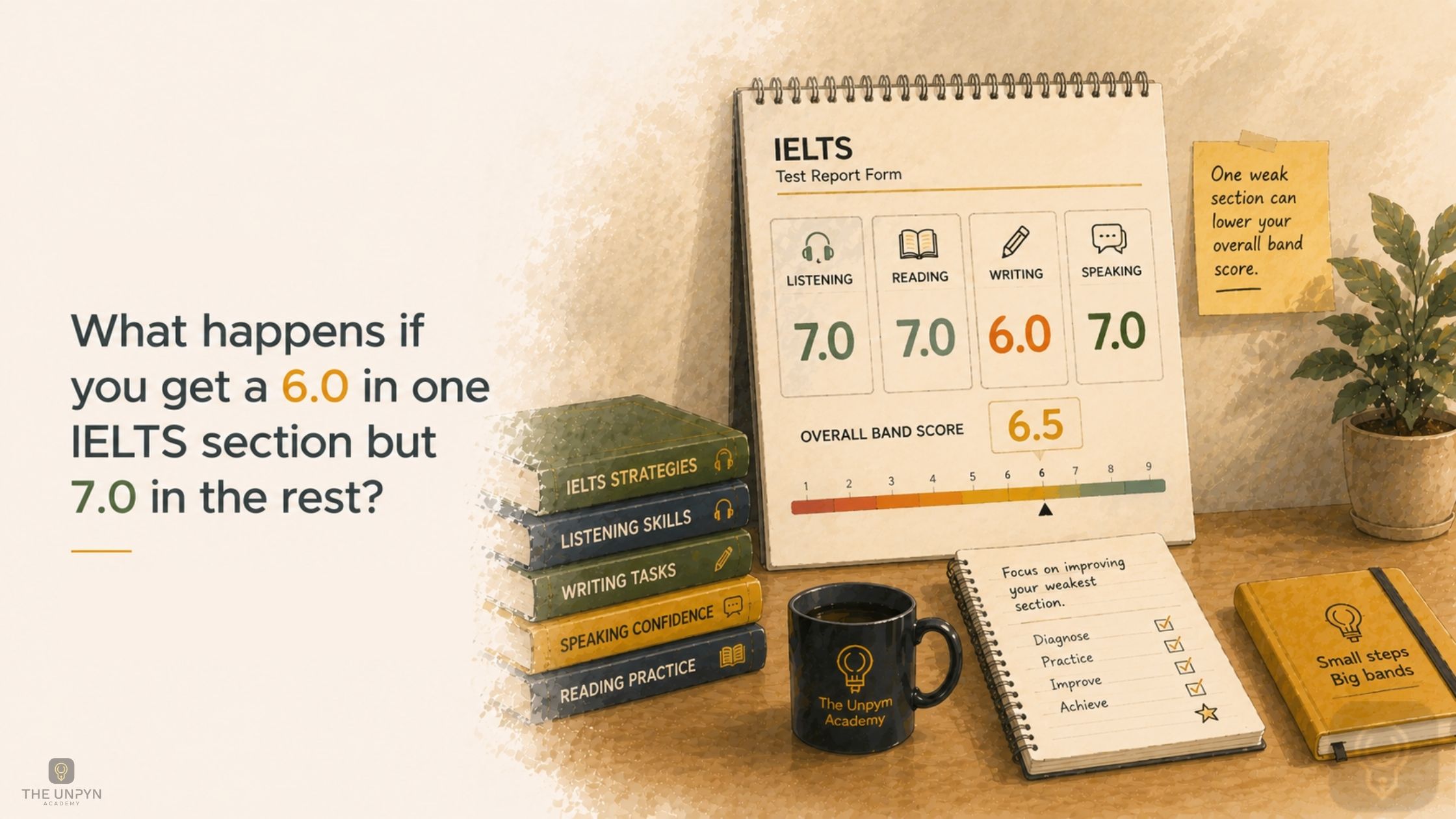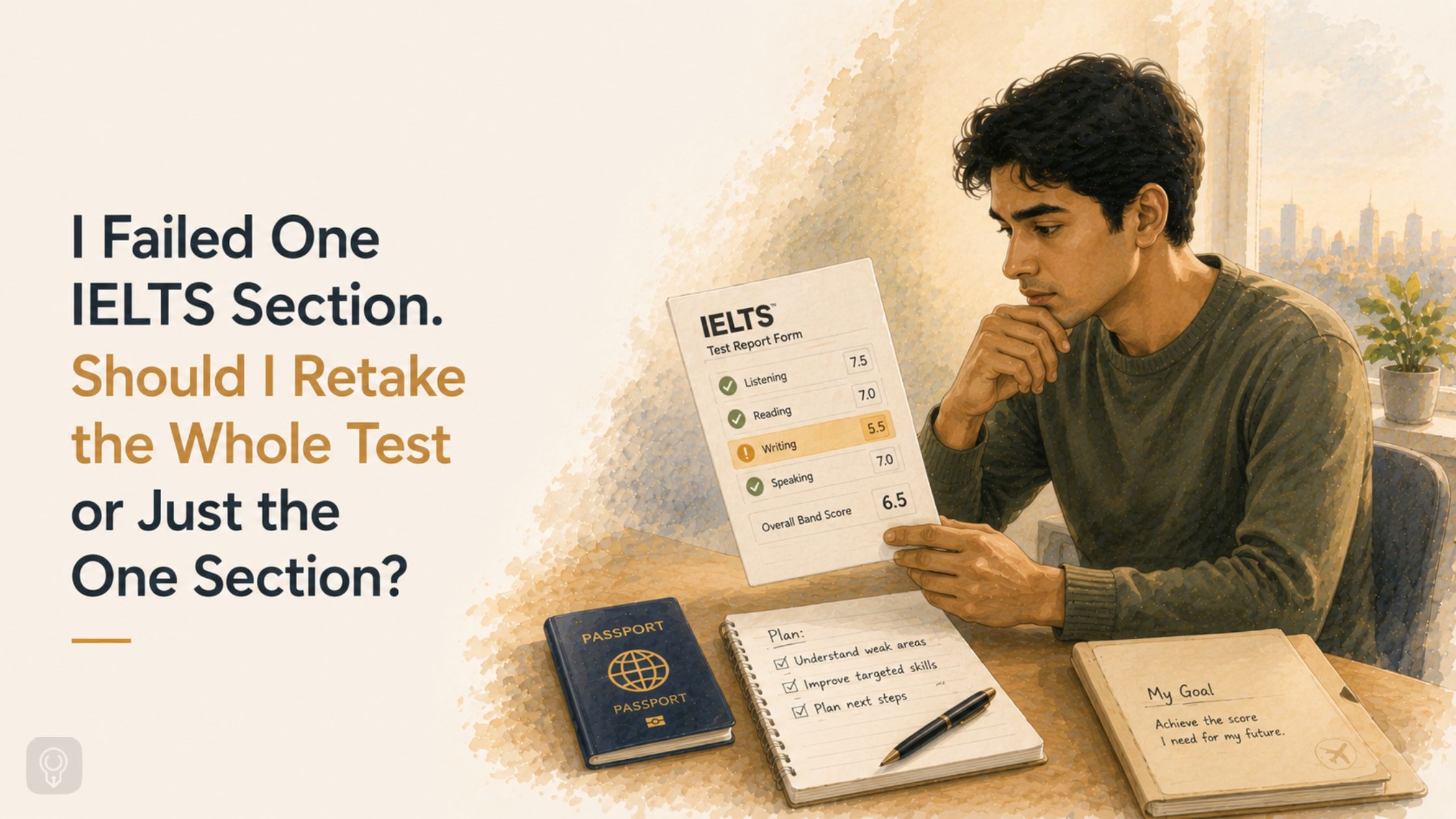
Your results are back. Three sections are exactly where you need them. One isn't.
Now you're weighing two options that feel very different: retake the entire test and risk the three scores you worked hard to get, or use the One Skill Retake and fix just the one section that let you down.
The answer depends on specifics — your gap, your timeline, your destination, and a few rules about the OSR that most people don't know until they've already made the wrong decision.
Here's the full picture.
What Is the One Skill Retake?
The IELTS One Skill Retake (OSR) allows you to retake a single section of the IELTS test — Listening, Reading, Writing, or Speaking — without sitting the other three again. Your new TRF (Test Report Form) combines your retake score with the original scores from your other three sections.
The key conditions:
- Only available for computer-delivered IELTS — not paper-based
- Must be booked and completed within 60 days of your original test date — this window is hard and non-negotiable
- One OSR per original sitting — if two sections need improving, you cannot do two OSRs from the same test
- The retake score replaces the original score for that section — even if it's lower. There is no option to keep the higher of the two
- The OSR costs ₹12,650 (as of May 2026)
The Decision Framework
Before choosing, answer these four questions:
How far below target is your weak section? If you missed by 0.5 bands (e.g., needed 7.0, got 6.5), OSR is well-suited — the gap is specific and closeable in 3–4 weeks. If you missed by 1.0 band or more (e.g., needed 7.0, got 6.0), a full retake may be more appropriate — a larger gap takes longer to close, and the 60-day window may not be enough.
Are your other three scores genuinely safe? The OSR replaces your score for the retaken section. But your other three scores don't change — and importantly, you're choosing not to retake those sections. If any of those three scores is already borderline, a full retake gives you the chance to improve across the board.
Are you applying to Canada? IRCC does not currently accept the One Skill Retake for Express Entry or most permanent residence applications. If Canada immigration is your purpose, OSR may not satisfy the requirement — verify directly at canada.ca/ircc before booking.
Is the 60-day window realistic? You have 60 days from your original test date to complete the OSR — not 60 days from when you get your results. If your results took 3–5 days, you have roughly 55 days left. Is that enough time to prepare meaningfully for the section that let you down? For Writing, 3–4 weeks of focused preparation with feedback is typically enough to close a 0.5 band gap. For Speaking, similar. For Listening and Reading, often faster. But if your gap is larger, 55 days may not be enough — and sitting the OSR underprepared is worse than waiting and doing a full retake properly.
The Most Expensive OSR Mistake
Booking the OSR immediately after results, without preparing.
This sounds obvious. But the panic of a disappointing result drives many people to book the OSR the same day — to feel like something is happening. Then 6 weeks later they sit the retake without having meaningfully fixed what went wrong, and they either score the same or, in some cases, lower.
Remember: if your OSR score is lower than your original, that lower score replaces it. There is no safety net.
The right sequence:
- Get results
- Identify specifically what went wrong — not just the score, but which criteria or question types
- Get targeted feedback or coaching on exactly that issue
- Practise until you are consistently hitting your target score in mock tests
- Then book the OSR — with enough time remaining in the 60-day window
When a Full Retake Is the Better Choice
OSR is the right tool for a specific, limited failure in an otherwise strong performance. A full retake may be better when:
- Your gap in the weak section is larger than 0.5 bands
- The 60-day window has passed or is too short for proper preparation
- Two or more sections are below target (OSR only covers one)
- You're applying to Canada via Express Entry (IRCC does not accept OSR)
- Your other three sections are borderline and could also be improved
- You want a fresh 2-year validity clock on all four scores simultaneously
A full retake also gives you the psychological clean slate of starting fresh — which some people find more motivating than the incremental repair of an OSR.
The OSR vs Full Retake Comparison
| One Skill Retake | Full Retake | |
|---|---|---|
| Cost | ₹12,650 | ₹19,000 |
| Time window | Must complete within 60 days of original test | Book any available date |
| Risk | OSR score replaces original — can go lower | All four scores are fresh |
| Canada IRCC | Not currently accepted | Accepted |
| Best for | 0.5 band gap, one section, time available | Larger gap, two+ sections, or Canada |
| Validity | New TRF covers the retaken section; original date for others | New 2-year validity across all four |
Before You Decide: Check Your Specific Requirement
Some institutions and visa authorities have specific policies about OSR results. Always confirm with your destination institution or visa authority that an OSR-combined TRF satisfies their requirement before you book.
Universities are generally flexible. UK immigration (UKVI) accepts OSR results. Australia's AHPRA accepts OSR for IELTS specifically (it's one of the few bodies that does). The NMC (UK nursing) accepts OSR-combined results. Canada IRCC does not.