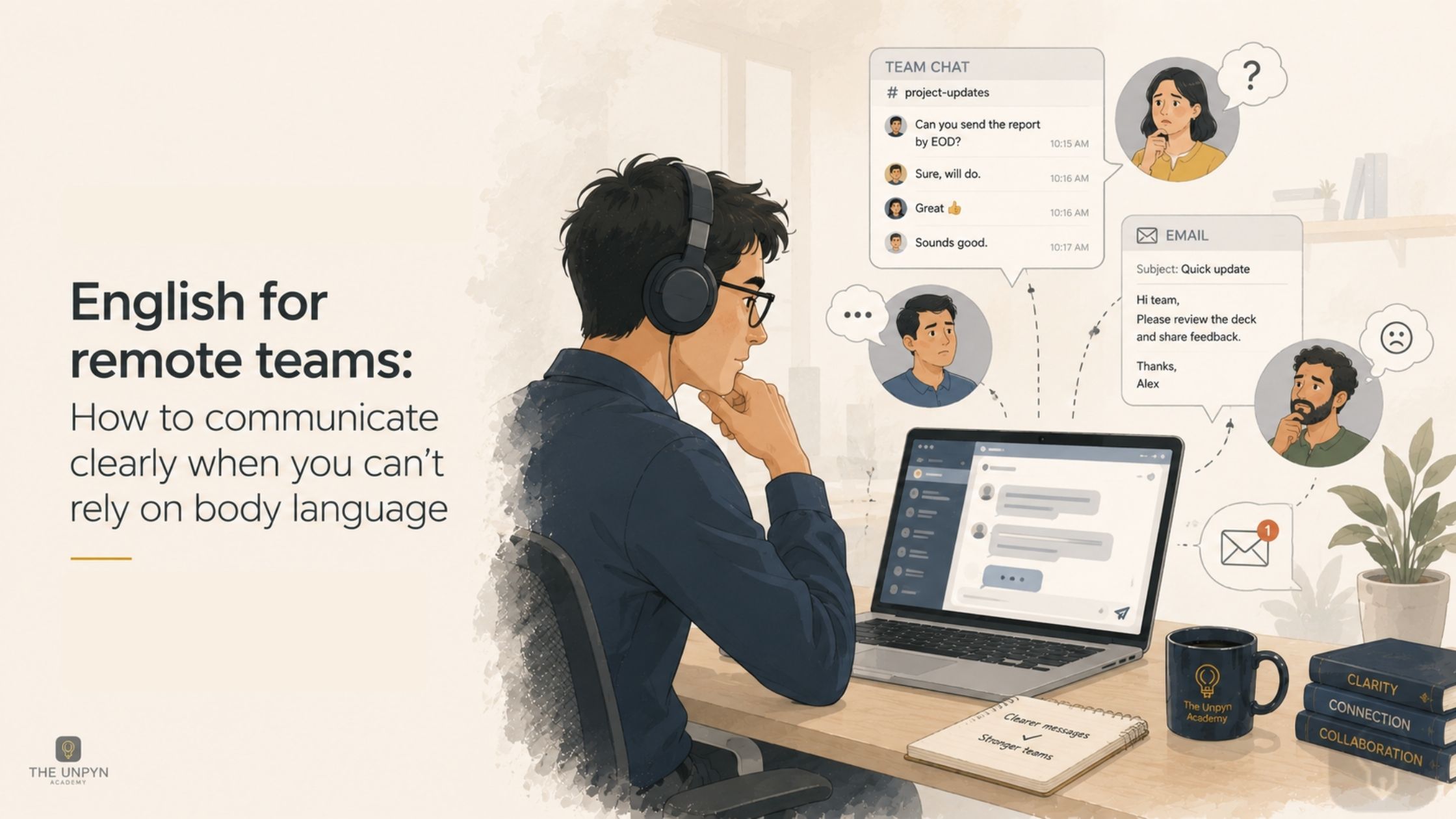
Think about the last time a message landed wrong. Maybe you sent something that felt perfectly clear to you, and the reply came back defensive. Maybe you received a two-line email from your manager and spent the next hour wondering whether you'd done something wrong. Maybe you wrote "Fine" in a Slack thread and someone read it as passive-aggressive.
None of those people were bad communicators. They were just working without the one thing that makes human communication work best: the ability to see and hear each other.
In a physical office, you'd catch your manager's tone of voice. You'd see the relaxed shoulders, the quick smile, the nod that signals "this is routine, don't worry." None of that travels through Slack. None of it survives a two-day email thread. And when English is your second language — when you're already translating nuance across a linguistic gap — the room for misreading doubles.
This is the real communication challenge for remote workers in 2026. Not vocabulary. Not grammar. The gap where body language used to be.
Why the Gap Is Bigger Than Most People Realise
Research on face-to-face communication is consistent: a significant majority of what we communicate is non-verbal — carried in facial expression, posture, gesture, and tone of voice. The words themselves carry a fraction of the meaning. Strip all of that away and replace it with a Slack message, and you're left with characters on a screen. The same sentence — "Can we talk about this?" — can mean "I want to discuss this collaboratively" or "You've done something wrong." In person, you'd know instantly. In text, you're guessing.
For remote workers communicating in English as a second language, the problem compounds. You might be reading a message in English and instinctively applying the social norms of your first language — where silence means respect, or directness means aggression — and arriving at entirely the wrong interpretation. The result is low-level stress from not knowing if your message landed the way you meant it, and it's quietly affecting productivity, trust, and career growth.
Part 1: Written Clarity — Say What You Mean, Completely
The single biggest mistake in remote written communication is assuming the reader has the same context you do. In an office, you can say "Can you update the report?" and the other person can ask a quick follow-up question. In async text, that message arrives with no context about which report, what kind of update, by when, or for what purpose.
The Complete Message Framework
Good async written communication answers four questions, even if the reader hasn't asked them:
What — exactly what are you asking for, or telling them?
Why — why does it matter? What decision or action does it inform?
When — what's the timeline? Is this urgent or can it wait?
What next — what should they do with this information? Reply? Decide? Take action?
A message that answers all four is almost impossible to misread. Compare these:
Before: "Can you check the proposal again?"
After: "Hi Priya, can you review the pricing section of the Q3 proposal (linked here) and let me know if the numbers look right before I send it to the client tomorrow morning?"
The second message takes 20 more seconds to write and saves 20 minutes of back-and-forth.
Structure Longer Messages So They're Scannable
Long messages get read partially, or not at all. If you're writing more than three or four sentences, put the most important thing first. A useful structure for longer async messages:
The ask or the point — one sentence at the top
The context — briefly, only what's needed
The specifics — details, links, deadlines
The next step — what you need from them, by when
Part 2: Tone in Text — The Invisible Minefield
Tone is where most people get into trouble. Written English has no natural intonation. A sentence that sounds warm when spoken can read as cold or passive-aggressive in text, depending on punctuation, word choice, and what the reader is bringing to it emotionally.
The One-Word Reply Problem
"OK." "Fine." "Sure." "Noted." In speech, these are perfectly normal. In text, they read as clipped, cold, or passive-aggressive to many English-speaking colleagues — particularly those from British and American work cultures where written warmth is an expected social signal.
Simple fix: add one sentence. "OK, I'll have that ready by Thursday." "Sure, will send over by end of day." The extra words signal engagement and goodwill.
The Too-Direct Request
In spoken English, directness is often fine because the voice does the softening. In text, direct requests without a softener can feel like commands between equals. Compare:
"Send me the updated version." — reads as instruction
"Could you send me the updated version when you get a chance?" — reads as request
"Can you send over the updated version before the call? Want to review it beforehand, thanks." — reads as collaborative
Punctuation Signals Tone More Than You Think
In professional text communication, a full stop at the end of a short message can read as cold or final. "That's fine." reads differently from "That's fine!" to many native English speakers in informal work contexts. This is especially relevant for Slack, Teams, and work chat tools — where the register is semi-informal and emotional tone is carried more by punctuation than in formal email.
Part 3: Async Communication — The Mindset Shift
The biggest conceptual error remote workers make with async communication is treating it like synchronous communication with a delay. It isn't. In synchronous communication, you can be incomplete because the other person will ask a follow-up question. In async, your message has to be complete when it leaves your hands.
The Cost of an Incomplete Async Message
An incomplete async message doesn't just cause confusion — it causes a delay, often a full day on cross-timezone teams, while the reader formulates a clarifying question, sends it, and waits for your reply. Two incomplete messages and you've burned a week of productivity on something that could have been resolved with one well-written message at the start.
Know When to Switch Modes
Not everything should be handled async. Async works well for: status updates, decisions that need input but not real-time discussion, documentation. It works badly for: sensitive feedback, emotionally charged situations, or anything where you're going round in circles in text. When a thread gets longer than five replies and the problem still isn't resolved — switch to a call.
Remote communication anxiety — the constant second-guessing of tone — is something we hear from professionals every week. Our Business English programme fixes exactly this.
Talk to a TrainerA Word on AI — Helpful Up to a Point
AI tools can polish a message quickly — catching grammar errors, tidying structure, and fixing obvious tone problems. That's genuinely useful as a second pass.
But AI cannot reliably replace your judgment on tone in specific professional relationships. It doesn't know your manager. It doesn't know the history of your team's communication culture. The things that make a message land — the relationship context, the emotional register, the cultural read — are human judgments. AI gives you a better draft. It doesn't give you communication intelligence.
The other problem: messages that are AI-polished but not authentically yours can read as generic in ways that undermine trust over time. Authentic voice, even imperfect English with genuine warmth, often builds more trust than polished prose with no personality. Use AI as a second pass, not a first voice.
The Underlying Skill: Thinking in English Before You Write
All of the above — written clarity, tone management, async communication — comes more naturally when you're not translating while you write. Many non-native English speakers working remotely form their thoughts in their first language and then render them into English. The result is often grammatically fine but slightly off in register, and the phrasing takes slightly longer to land.
The people who communicate most effectively in remote English-speaking environments are those who have moved past translation and into thinking in English directly. It's a muscle, and it builds with deliberate daily use — not just during formal practice, but in the actual communication of the work day. This is what Business English coaching is really about, at its best.