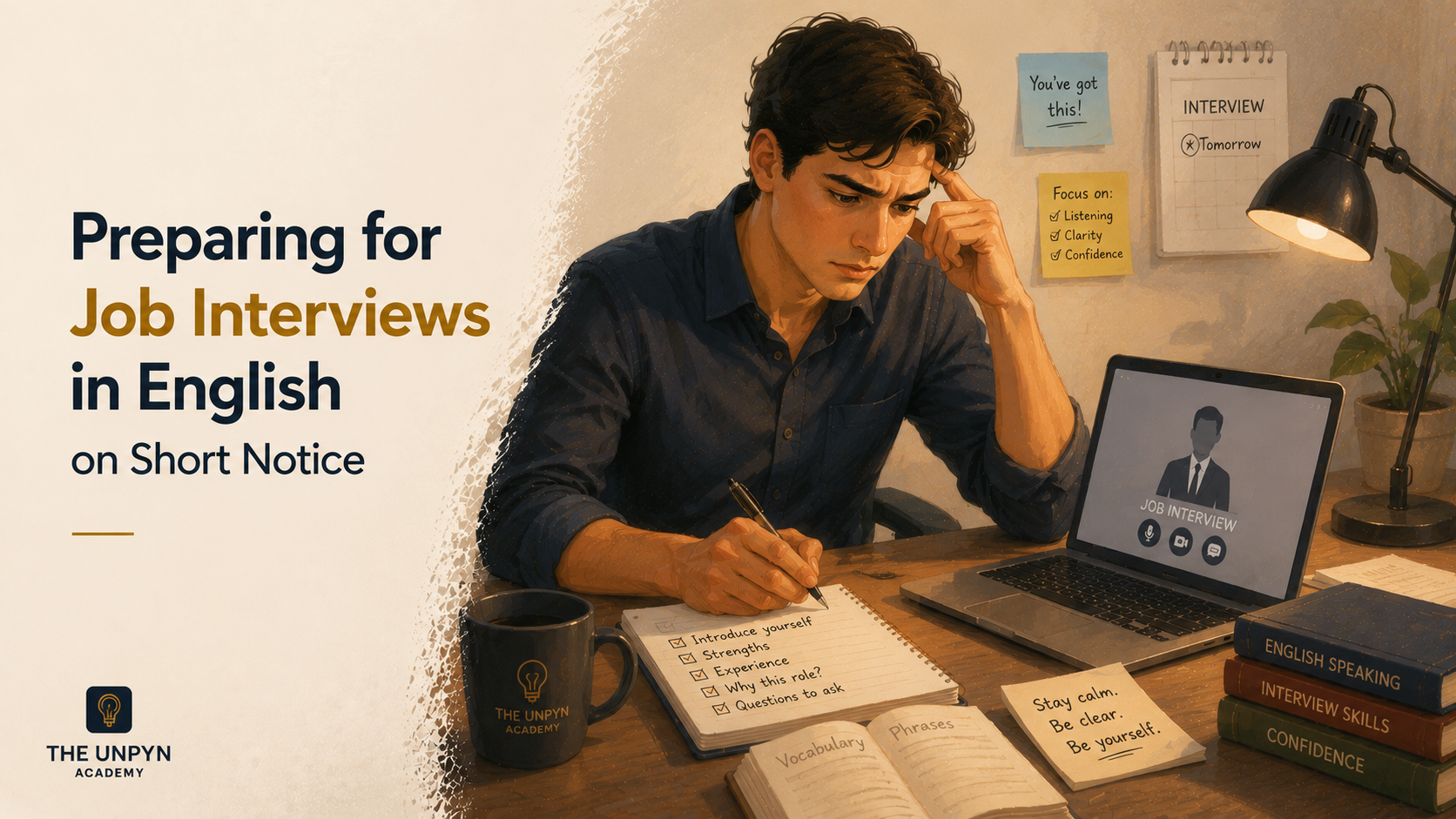
The interview is in 48 hours. Or 72. Or a week, which also feels short when you're thinking about it.
You've prepared the content — you know what you've done, what you're good at, what the role involves. But the delivery is a different problem. Speaking English in a high-stakes, real-time conversation with a stranger who's evaluating you is genuinely harder than anything else you do in English, and it's the one thing you can't fully rehearse alone.
This is about making the preparation time you actually have count.
What an Interviewer Is Actually Assessing
Before any preparation, understand what an interviewer is listening for — because it changes how you prepare.
They're not marking your grammar. They're assessing: Can this person communicate clearly? Can they think on their feet? Do they understand what's being asked? Can they recover when they're unsure?
This means a clear, confident, slightly slower answer with one minor grammatical slip beats a rushed, anxious, grammatically perfect answer every time. And it means that saying "I want to make sure I understand your question — are you asking about X or Y?" is a sign of competence, not weakness.
That one reframe — from "don't make mistakes" to "communicate clearly" — changes what you practise.
Hour 1: Clarification Phrases (The Most Underused Skill in English Interviews)
Most non-native speakers in interviews are terrified of not understanding a question. So they nod and answer something — often the wrong thing — rather than ask for clarification.
The result: a confident-looking non-answer that raises more doubts than asking a simple clarifying question would have.
Clarification is not a signal of confusion. It's a signal of precision. The best communicators in any language clarify ambiguous questions before answering them — because they've learned that answering the wrong question confidently is worse than pausing to confirm the right one.
Clarification Phrases to Have Ready
When you didn't fully catch the question:
- "I'm sorry, could you repeat that? I want to make sure I answer what you're actually asking."
- "Forgive me — could you say that again? I want to give you a proper answer."
- "Sorry, I missed the second part of that — could you rephrase it?"
When you heard it but aren't sure what they're looking for:
- "Could you help me understand — are you asking about [X] or [Y]?"
- "Just to make sure I'm answering the right question — are you asking about [specific aspect]?"
- "Is the focus more on [X] or [Y] from your perspective?"
When the question is very broad and you want to narrow it:
- "That's a broad area — could I ask which aspect is most relevant for this role?"
- "There are a few ways I could answer that — would it be most useful to focus on [X]?"
The key: ask one clarifying question clearly and move straight to your answer once you have the confirmation. Don't ask multiple clarifying questions — that starts to look like avoidance.
Hour 2: Buy-Time Strategies That Sound Confident
There's a version of "buying time" that sounds confident and a version that sounds desperate. The confident version is used by senior professionals everywhere. The desperate version is a long silence with a panicked expression.
Phrases That Buy Time Without Signalling Panic
Starting the clock:
- "That's a really interesting question — let me think about that for a moment."
- "I want to give you a considered answer on that rather than the first thing that comes to mind."
- "Let me think through the best example to illustrate that."
Organising your thinking aloud:
- "So there are a few dimensions to this — I'll start with [X]."
- "The way I think about this is..."
- "Off the top of my head, the most relevant example I can think of is..."
Transitioning when you need to redirect:
- "I want to make sure I'm actually answering what you're asking — is the focus more on [X] or [Y]?"
- "I've been speaking about [X] — is that the direction that's most useful, or would you like me to focus on [Y]?"
The buy-time phrases work because they signal thinking, not confusion. They communicate "I'm taking this seriously" rather than "I don't know what to say."
Hour 3: The STAR Framework — Fast Version
Most interviews for professional roles involve behavioural questions: "Tell me about a time when you..." "Give me an example of..." "Describe a situation where..."
These are easier to answer than they feel — if you have a structure. The STAR framework (Situation, Task, Action, Result) gives you a template that works for almost every behavioural question.
Situation: One sentence setting the context. Where, when, what was the challenge. Task: One sentence explaining what your specific responsibility was. Action: Two to three sentences describing what you specifically did. Use "I" not "we" — they're assessing you. Result: One sentence on the outcome. Numbers help ("reduced by 30%," "completed two weeks early"), but qualitative outcomes work too ("the client renewed the contract").
The whole answer should take 90 seconds to two minutes. Not longer. Interviewers who want more will ask.
The preparation move: write down five to six past situations that demonstrate relevant skills for the role. For each one, write out the STAR in bullet points. Don't memorise the words — memorise the structure and the key facts. The words will come in the room.
Hour 4: The Specific Situations That Trip People Up
"Tell me about yourself." This is not an invitation to recite your CV. It's asking for your narrative — the story that connects where you've been to why you're here. Two to three minutes maximum. Structure: where you started, what shaped your expertise, why this role specifically.
"What are your weaknesses?" The formula that works: name a real weakness, describe what you've done about it, and show the trajectory. Not "I work too hard" (no one believes it) and not a critical flaw with no resolution. "I've historically struggled with delegating — I tend to want to control quality directly. I've been working on this by [specific approach] and I've seen [specific improvement]."
"Do you have any questions for us?" Always have two prepared. Questions that signal you've thought about the role: "What does success look like in this role after six months?" "What are the biggest challenges the team is currently facing?" Avoid asking about salary or holidays in a first interview unless they raise it.
The question you genuinely don't know the answer to: "That's not an area I have direct experience in — but here's how I'd approach it..." followed by your thinking process. An honest, thoughtful non-answer is considerably better than a fabricated answer that falls apart under follow-up.
The Day-Before Practice Session
Do this once, out loud, the day before:
- Introduce yourself (two minutes)
- Answer "Why this role?" (one minute)
- Answer one behavioural question from your prepared list (two minutes)
- Ask your two questions
Record it on your phone. Listen back. You'll hear exactly where you hesitate, where you rush, and where you use a filler word that's covering uncertainty. Fix those specific moments in a second run-through.
That's it. Two run-throughs the day before, focused on the moments that need work. Not a full day of anxious rehearsal — specific, targeted practice on the things that actually trip you up.
The Night Before
Don't practise. Preparation is done. Review your notes if it settles you. Sleep. The cognitive sharpness that comes from rest is worth more to your interview performance than another hour of rehearsal.
What You're Actually Competing On
In most professional interviews, the hiring decision comes down to two questions: can this person do the job, and do I want to work with them? Your English fluency is relevant to the first question only insofar as the role requires communication. The second question — likability, presence, confidence — is completely within your control.
Clear structure, a calm pace, genuine engagement with the questions, and the ability to say "let me make sure I understood that correctly" when needed: these are the signals that build the answer to both questions in your favour.