This is one of the most searched Canada-related questions on the internet, and it generates a lot of conflicting answers.
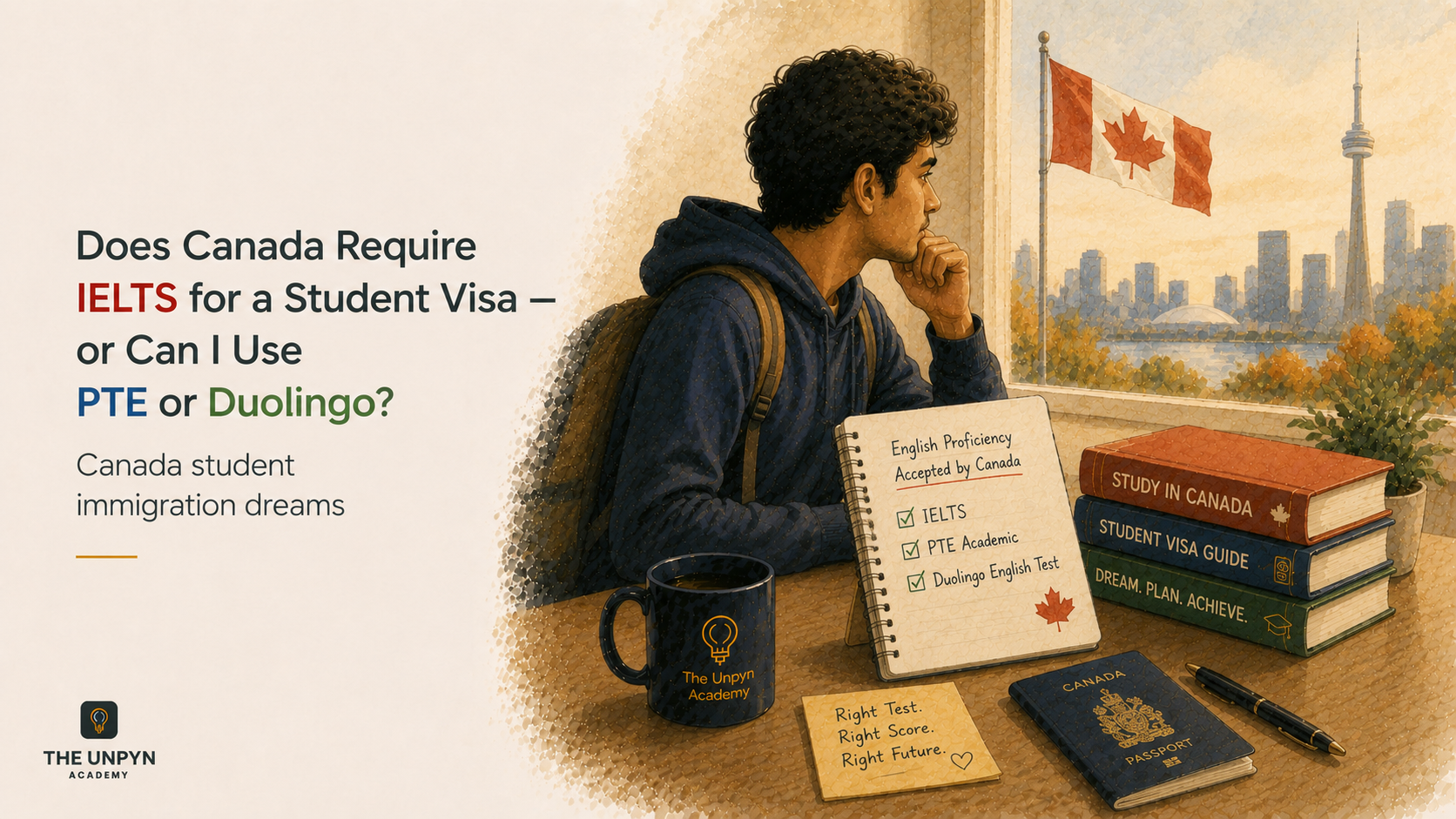
The short answer: Canada's study permit doesn't require a specific English test. But your university almost certainly does — and those are two different requirements that often get confused.
Let's separate them properly.
The Two Requirements: University vs Study Permit
When you apply to study in Canada as an international student, there are two separate processes involved:
University/College Admission: The institution sets its own English language requirements. They specify which tests they accept and what scores they require. This is handled entirely between you and the institution.
Canadian Study Permit (Student Visa): Issued by IRCC (Immigration, Refugees and Citizenship Canada). IRCC processes your study permit application based on your acceptance letter from the institution, your financial documents, and other eligibility factors.
Here's the critical point: IRCC does not require applicants to submit a specific English language test result as part of the study permit application. The institution's acceptance letter — which you receive after meeting their requirements, including English proficiency — is what IRCC uses as evidence that your language is sufficient.
This means: if your university accepts Duolingo and you meet their score requirement, you can receive an acceptance letter without IELTS. When you submit your study permit application to IRCC with that acceptance letter, no separate English test is required.
So Why Do People Think They Need IELTS Specifically?
Two reasons:
First, IELTS has been the default English test for so long that many people assume it's a government requirement. It isn't for study permits. It is the requirement of many individual universities — but not of IRCC.
Second, IELTS is required for some other Canadian immigration pathways (Express Entry, work permits). People researching "English test for Canada" encounter this information and apply it incorrectly to student visa applications.
What Test Does Your University Actually Require?
This is the question that actually determines which test you take. And it varies by institution, by programme, and sometimes by faculty.
Here's the general picture for 2026:
IELTS General Training — not accepted for Canadian university admissions. Only IELTS General Training is accepted for immigration purposes — for admissions, universities require IELTS Academic specifically.
IELTS Academic — accepted by virtually all Canadian universities. The most universally accepted option.
PTE Academic — accepted by approximately 90% of top Canadian universities. Growing quickly. If your target institution is on the acceptance list, PTE Academic is a valid alternative with faster results.
Duolingo English Test — accepted by many Canadian universities, particularly for undergraduate admissions. Acceptance at graduate level varies by programme. Canada shows strong institutional acceptance, with approximately 90% of top Canadian universities by international student enrolment accepting DET for undergraduate study.
CELPIP — accepted by some Canadian institutions and widely used for Canadian PR, but not commonly required for university admissions.
Score Requirements at Major Canadian Universities
| University | IELTS Academic Minimum | PTE Academic | Duolingo |
|---|---|---|---|
| University of Toronto | 6.5 overall, no band below 6.0 | ~60 | 120 |
| University of British Columbia | 6.5 overall | ~60 | 120 |
| McGill University | 6.5 overall | ~60 | 120 |
| University of Waterloo | 6.5–7.0 | ~60–65 | 115–120 |
| University of Alberta | 6.5 overall | ~59 | 115 |
| Ryerson (Toronto Metropolitan) | 6.5 overall | 58–65 | 110–120 |
| York University | 6.5 overall | 58 | 115 |
Disclaimer: Score requirements vary by programme and faculty — the graduate school of business may require higher scores than the undergraduate arts faculty at the same university. Always verify the specific requirement for your target programme directly on the institution's admissions page. Requirements are updated frequently.
The Situation Where You Might Need IELTS Specifically
There are two situations where IELTS specifically matters for Canada:
Situation 1 — Your programme requires it. Some competitive programmes — law, medicine, nursing — specify IELTS Academic specifically rather than accepting multiple tests. Always check the programme requirements, not just the university homepage.
Situation 2 — You're also applying for Canadian immigration after graduating. If you plan to apply for a Post-Graduation Work Permit (PGWP) and then Express Entry for PR, you will eventually need IELTS General Training (or PTE Core or CELPIP) for the immigration pathway. This is a separate requirement from your studies — but worth planning for early if you know PR is the goal.
The Duolingo Situation for Canada: Admissions vs Visa
One of the most common points of confusion specifically:
Duolingo for Canadian university admissions: Accepted by most major Canadian universities. No visa complications — the study permit doesn't require a specific test.
Duolingo for Canadian immigration (PR, work permit): Not accepted by IRCC. Duolingo has no role in Express Entry, PNP, or work permit applications.
This means if you're a student who wants to study and then stay in Canada permanently, Duolingo can cover your university admission but won't cover your eventual PR application. You'll need IELTS General Training or PTE Core for that — which is fine, as long as you plan for it and don't let your English score lapse while you're in Canada.
The Practical Decision Tree
Step 1: Look up the English test requirements for your specific programme at your target Canadian institution — not just the university homepage.
Step 2: Check whether Duolingo, PTE, or IELTS Academic is accepted for that programme.
Step 3: Choose based on: which test you'll score best on, how quickly you need results, and whether you need a visa for another purpose simultaneously.
Step 4: If you're also planning for Canadian PR after graduation, begin planning for IELTS General Training or PTE Core at some point before you apply — ideally not in a rush.